


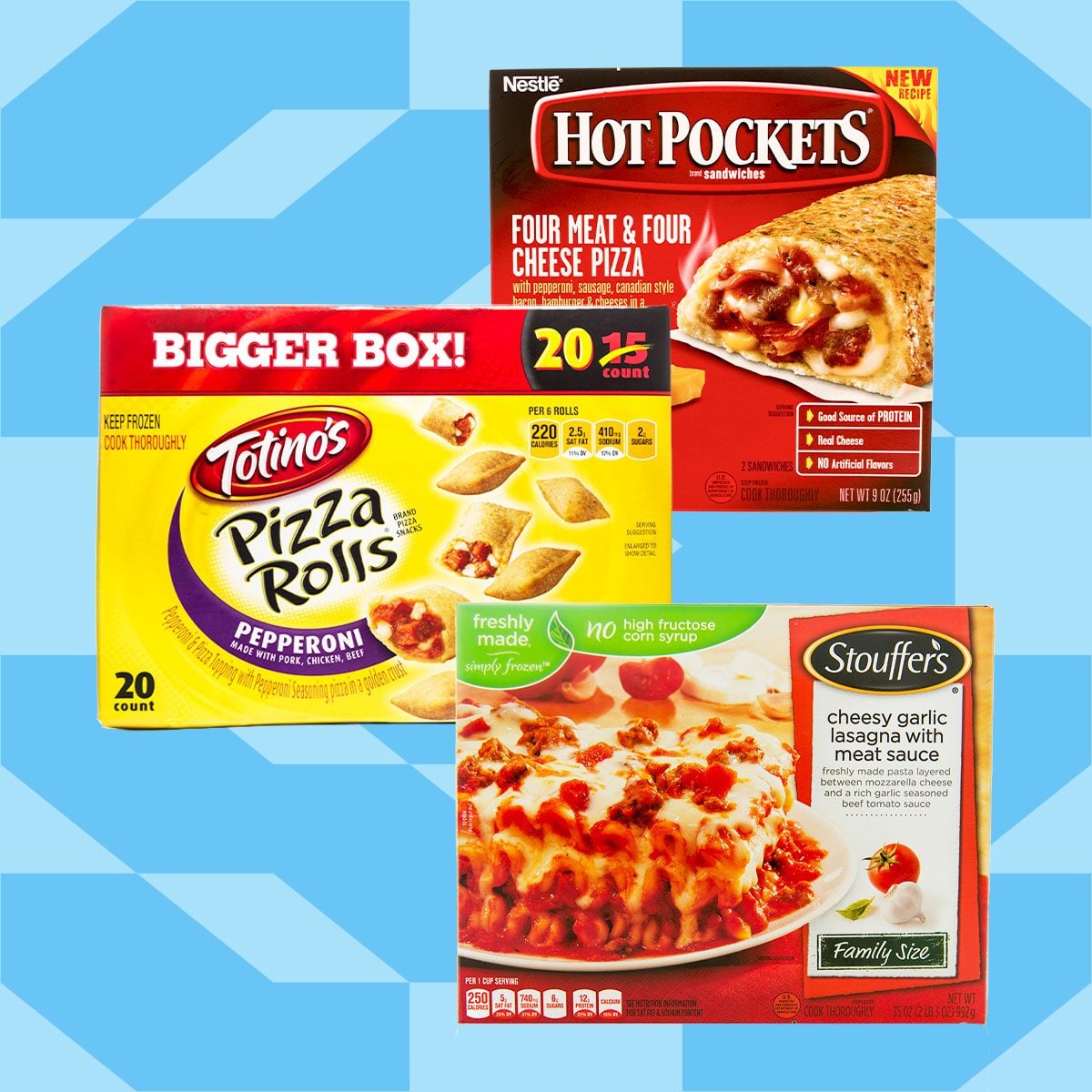

The foods that filled America's freezers in 2003 tell a surprisingly revealing story. From diet culture to busy weeknights, these dinners captured a moment in time.
I graduated from high school in 2003. At 18, I was an incurable theater kid with a flip phone I thought was impossibly cool, a part-time job waiting tables and just enough wide-eyed optimism to mistake a paycheck and a cheap car for adulthood. Food barely crossed my mind beyond whatever I grabbed before a shift or between rehearsals. The idea that it would one day become the center of my profession would’ve seemed far less believable than anything I ever did on stage.
The year was a strange, unmistakable moment in America’s history. The country was still finding its footing after 9/11, even as pop culture barreled ahead. American Idol had turned ordinary people into overnight celebrities, reality TV was exploding, broadband internet was reshaping everyday life, and convenience was becoming the default in just about every corner of American culture—including in the kitchen.
On weeknights across America, dinner often came from the freezer. Families stocked their kitchens with frozen meals promising everything from hearty comfort to a smaller waistline. At the same time, the country was tying itself in knots over nutrition. Decades of low-fat messaging were colliding with the exploding Atkins craze, and grocery stores were filling their freezer cases with wildly different ideas about what “healthy” meant. Americans were just doing their best to keep up. Looking back, the frozen-food aisle was an unexpectedly revealing snapshot of life in 2003.
Stouffer’s Lasagna

By 2003, Stouffer’s lasagna wasn’t the newest thing in the freezer aisle, but it didn’t have to be.
There was something reassuring about pulling a bubbling pan from the oven. It wasn’t homemade lasagna, but it still felt like someone had made dinner. On busy Tuesday nights after everyone had finished arguing over whose turn it was to use the family computer, that counted for a lot.
While flashier frozen meals came and went, Stouffer’s had become the dependable standby. It was the meal you reached for when you wanted dinner to feel just a little more like dinner.
Lean Cuisine

The early 2000s freezer aisle had a bit of an identity crisis.
For years, Americans had been told that fat was the nutritional villain, and Lean Cuisine became one of the biggest names in lighter, portion-controlled meals. Then the Atkins craze arrived, and suddenly carbs were the enemy.
The rules seemed to change overnight, but the underlying message stayed the same. Dinner was more than just dinner; it was another opportunity to “improve yourself.” Lean Cuisine adapted rather than disappearing, introducing reduced-carbohydrate entrees in 2003 as the low-carb craze reached its peak.
Hungry-Man Dinners

Then, just a few freezer doors away, there was Hungry-Man.
If Lean Cuisine represented one side of 2003, Hungry-Man represented the other. While one promised restraint, the other proudly piled on fried chicken, mashed potatoes and enough gravy to make you forget that anyone was talking about portion control.
It feels almost funny in retrospect. Depending on which freezer door you opened, America was either terrified of dinner or convinced it wasn’t nearly big enough. That push and pull summed up the food culture of 2003 better than just about anything else.
Kid Cuisine

If your parents bought Kid Cuisine, you probably remember which compartment you always ate first.
Depending on the meal, it might have held chicken nuggets, macaroni, corn and—most importantly—a little brownie tucked into its own special compartment, all under the watchful eye of the brand’s cartoon penguin.
Rather than competing with a homemade dinner, Kid Cuisine was trying to win over 8-year-olds. And knew exactly how to do it.
Healthy Choice

Healthy Choice wrapped its promise right into the name.
It wasn’t selling a specific diet so much as the idea that you could make one good decision at dinnertime and feel a little better about everything else. That message landed at exactly the right moment. Americans were trying to navigate a constant stream of changing nutrition advice, and grocery stores were more than happy to offer the answer.
Looking back, a lot of the messaging feels dated at best. The freezer aisle was crowded with meals suggesting that eating less—and taking up less space—was something to aspire to.
Kraft Mac & Cheese

To me, Kraft Mac & Cheese tastes like summer. My best friend lived across the street, and we were in her pool almost all day, every day, from May until October. Around lunchtime, her mom would call us inside, hand us towels and set steaming bowls of Kraft Mac & Cheese on the kitchen table. We’d dry off just enough to not drip all over the floor, inhale our bowls, and then head straight back outside to our inflatable rafts and Britney Spears CDs.
I can’t look at a box of Kraft Mac & Cheese without thinking about those afternoons. By 2003, the blue box had already earned its place in kitchens across America for much the same reason, becoming part of growing up for millions of kids.
Weight Watchers Smart Ones

If Lean Cuisine suggested moderation, Smart Ones turned it into a math problem.
For the millions of Americans following Weight Watchers, dinner came with a Points system. Suddenly, every meal became part of a much bigger equation, making it easier to stay on track—but also a little harder to simply enjoy what was on your plate. In 2003, the freezer aisle was selling self-improvement dressed up as dinner.
Totino’s Pizza Rolls

If Kid Cuisine belonged to the little kids, Pizza Rolls belonged to their older siblings. They were sleepover food, after-school food and Mom’s-still-at-work food. Every kid seemed to learn the same lesson the hard way: Just because it looked cool enough to eat didn’t mean the inside wasn’t still the temperature of the sun.
Some childhood experiences are practically universal. Burning the roof of your mouth on a Totino’s Pizza Roll was one of them.
DiGiorno Pizza

Few food slogans have had the staying power of “It’s not delivery. It’s DiGiorno.”
By 2003, the line was already everywhere, helping to convince families that frozen pizza didn’t have to taste like a backup plan. Whether it actually rivaled the pies made by your favorite pizzeria depended entirely on who you ask, but the slogan itself was enough to cement DiGiorno pizza into the culture.
If you rented a movie from Blockbuster on a Friday night in 2003, there’s a decent chance a DiGiorno pizza wasn’t far behind.
Hot Pockets

By 2003, Hot Pockets were everywhere—just a few years before Jim Gaffigan would immortalize them in one of stand-up’s most famous bits. Nestle had acquired the brand the year before, and sales were skyrocketing.
They were the snack you grabbed while watching TRL after school, or while running around before soccer practice. Folded into their signature cardboard sleeve, they were portable enough that you didn’t even have to sit down to eat one. That fit the moment. Americans were looking for quick, convenient meals, and Hot Pockets were riding that wave.

