


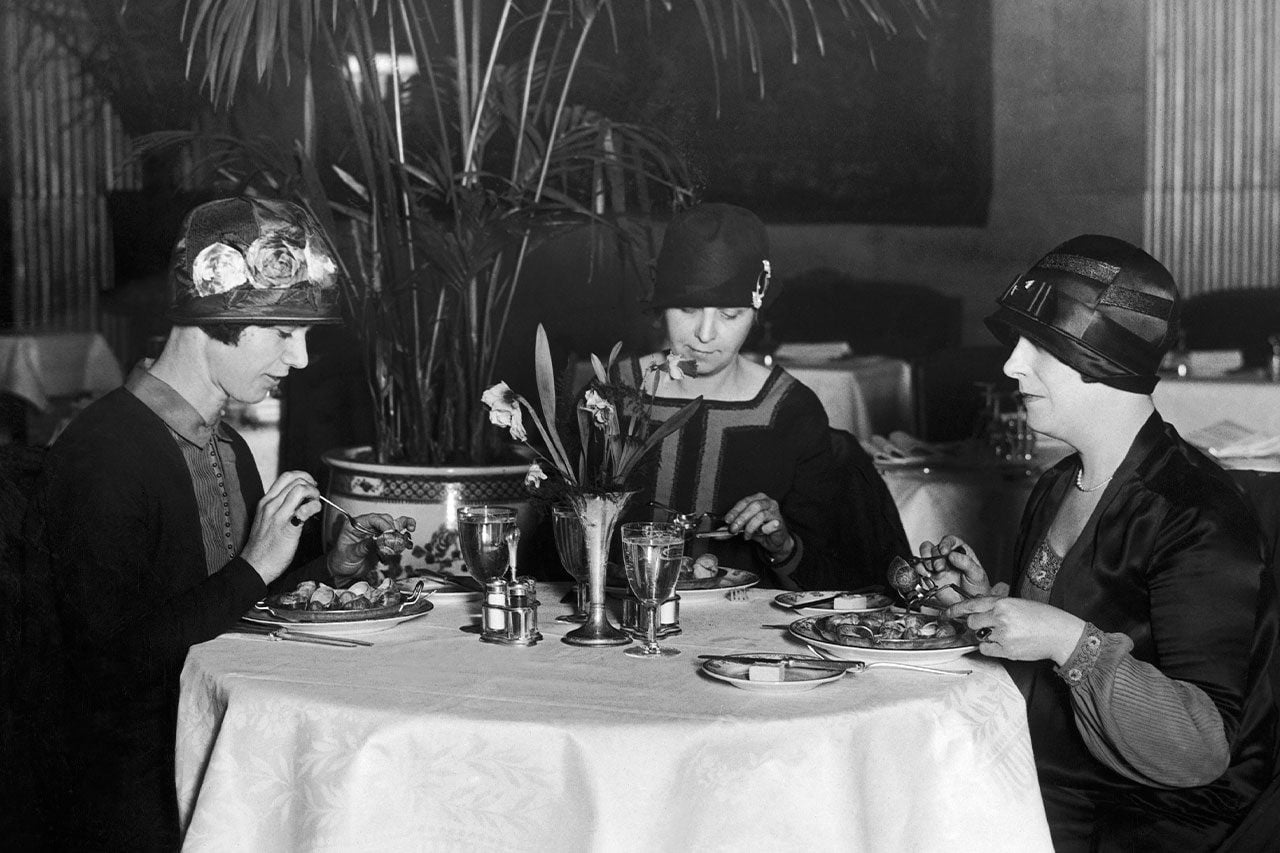

Despite Prohibition, Americans with the means to dine out were living it up with meals full of rich French sauces, flaming desserts like baked Alaska, and an oyster dish named after one of the richest men in the country.
For someone who makes a living with words and prefers to spend all her free time lost in literature, admitting how much I love Fitzgerald and Hemingway hardly qualifies as a revelation. It’s the literary equivalent of saying your favorite movie is The Godfather or your favorite band is The Beatles. But every few years, I pick up my copy of The Beautiful and Damned or The Sun Also Rises and remember exactly why these writers became literary shorthand for greatness in the first place. So many American writers of the 1920s endure not just for their stories, but for the world they captured. The Jazz Age has always held a kind of magic for me. It’s impossible not to romanticize an era that embraced excess with such unapologetic confidence.
Of course, reality was far more complicated. The era’s splendor belonged to a privileged few, while inequality remained deeply entrenched. Prohibition was in full swing, and the stock market crash that would bring the Roaring Twenties to a screeching halt was just a few years away. But in 1926, few people knew the party was nearing its end. Restaurants embraced the decade’s appetite for extravagance, serving elaborate, French-inspired meals that unfolded over multiple courses. They were advertising an ideal of sophistication.
Spend enough time reading through restaurant menus from the ’20s, and they begin to tell a story every bit as clearly as the novels of the era. If you were lucky enough to dine in one of the country’s most fashionable restaurants a hundred years ago, these are the dishes you might have found on the menu.
Oysters Rockefeller

By 1926, this New Orleans classic had already spent nearly three decades cementing its place on America’s finest menus. Rich, buttery and lavishly topped with herbs, oysters Rockefeller wasn’t just an appetizer. It was a statement of intent.
The name wasn’t arbitrary. Chef Jules Alciatore of Antoine’s Restaurant in New Orleans created the dish in 1889, deciding that only America’s richest man was an appropriate comparison. There was nothing subtle about naming a plate of oysters after John D. Rockefeller, just as there was nothing particularly subtle about the era’s fascination with wealth.
The comparison wasn’t meant to be clever. It was meant to be obvious. If you saw this popular dish on a menu in 1926, everyone at the table understood exactly what the restaurant was trying to say.
Canapés
Prohibition didn’t put much of a dent in America’s appetite for entertaining. While alcohol moved behind closed doors, elegant dinners and cocktail hours continued, where canapés offered guests a polished first bite before the meal began.
Rather than a single recipe, canapés were an entire category of bite-sized appetizers. Small pieces of toasted bread might be topped with smoked salmon, caviar, paté, anchovies or other ingredients, each designed to be eaten in a bite or two without distracting from the courses still to come.
Consommé
If oysters Rockefeller and fancy canapés announced the evening, consommé quietly demonstrated the kitchen’s confidence.
A perfectly clear broth doesn’t sound especially glamorous today, but in 1926, it was one of the surest signs you were dining somewhere exceptional. Clarifying stock until it was brilliantly transparent required patience, precision and more than a little skill. There was nowhere for a chef to hide.
That’s one of the biggest surprises hiding in old menus. Sometimes the point wasn’t to dazzle with ingredients, but with flawless execution.
Waldorf Salad

Created at New York’s Waldorf-Astoria Hotel in the 1890s, the Waldorf salad was a classic in 1926. It offered a crisp counterpoint to all the heavy cream sauces and butter that dominated so many menus. The original version was even simpler than the recipe most of us know today, proving that sometimes restraint has its own appeal.
Celery Victor
Celery Victor was one of the dishes that helped define fine dining at San Francisco’s St. Francis Hotel in the 1920s. Created by chef Victor Hirtzler, it elevated humble celery hearts with classic French technique, gently cooking them before serving them chilled with a bright vinaigrette and fresh herbs.
Today, celery is the vegetable that quietly disappears into soups, stews and stuffings. A century ago, it was sophisticated enough to anchor a signature dish at one of the country’s most fashionable hotels.
Chicken à la King

Few dishes were more in vogue in the 1920s than chicken à la king, but no one seems to agree exactly who invented it. Depending which story you believe, it originated in New York, Philadelphia or even England. The one thing everyone agrees on is that by the Roaring Twenties, this plate of cream, mushrooms, peppers and tender chicken had become a fixture of hotel dining rooms, private clubs and first-class restaurants.
Eggs Benedict

Luxury wasn’t reserved strictly for dinner. By 1926, many restaurants had turned breakfast into an event of its own, and eggs Benedict had become one of the era’s signature dishes.
At first glance, it seems almost ordinary: an English muffin topped with Canadian bacon, a poached egg and Hollandaise sauce. But like so many classics of the time, its appeal wasn’t built on high-end ingredients, but flawless technique. Hollandaise had to be silky, with the egg perfectly poached and every component served at exactly the right temperature. Like consommé, it rewarded precision over spectacle.
Lobster Thermidor
Lobster Thermidor arrived from France a few decades earlier, but by 1926, America’s restaurants had embraced it wholeheartedly. Lobster meat was folded into a rich sauce of butter, cream, egg yolks and wine, returned to the shell, then browned until bubbling. It was exactly the sort of elaborate, French-inspired dish diners expected to find on the menus of the country’s most elegant dining rooms.
It’s hard not to notice how often luxury was measured in rich sauces. Lobster Thermidor wasn’t content to let the shellfish speak for itself. Like so many dishes of the 1920s, it dressed extravagance in another layer of extravagance. Subtlety wasn’t getting many reservations in 1926.
Lobster Newberg

If you were hoping for a break from lobster, this is not your decade. Lobster Thermidor showcased America’s admiration for French cuisine, while lobster Newberg proved the country’s leading restaurants were beginning to develop a few signature dishes of their own.
This New York original paired lobster with a sauce of butter, cream, egg yolks and sherry, creating a rich centerpiece that soon appeared on the menus across the country. Side by side, Thermidor and Newberg reveal just how much 1920s restaurants prized abundance. And butter.
Peach Melba

By the time the Roaring Twenties reached their peak, Auguste Escoffier had already become the defining figure of modern French cuisine. One of his most enduring creations, peach melba, paired poached peaches with vanilla ice cream and raspberry sauce in a dessert named for Australian opera singer Nellie Melba. By 1926, it had become a familiar finale to an elaborate meal.
Cherries Jubilee

By the time dessert arrived, restaurants had one last opportunity to surprise their guests. Cherries jubilee did exactly that. Warm cherries in a rich syrup were paired with vanilla ice cream before receiving a splash of liqueur and a dramatic tableside flambé. The brief burst of flames lasted only a moment, but it transformed dessert into something diners would remember long after the meal was over.
Baked Alaska

If there was one dessert that embodied the era’s flair for spectacle, it was baked Alaska. On paper, it sounds like someone just fundamentally misunderstood how ovens work. Yet somehow, a shell of browned meringue protected the ice cream underneath, creating one of the most theatrical desserts of its day. For 1920s diners, it was proof that the kitchen could do something almost magical.

