
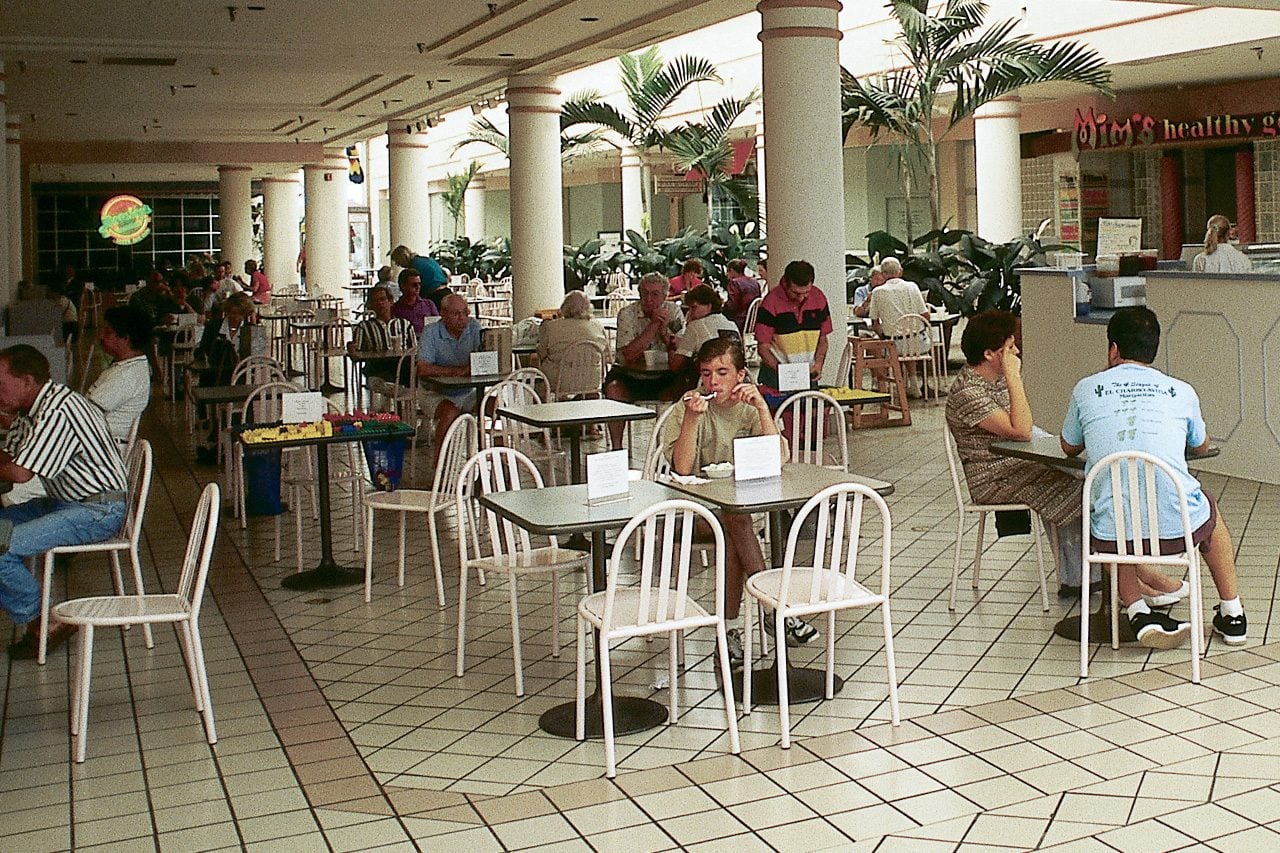

Before online shopping changed everything, the mall was where we spent our Saturdays—and the food court was half the reason to go.
I was 10 years old in 1995, which was an excellent year to be an aspiring teenager. Clueless, a film that would permanently alter the brain chemistry of millennial women, was in theaters; TLC and Alanis Morissette were all over the radio; Friends had made “The Rachel” unavoidable, and the mall was still the center of the adolescent universe.
In 1995, the mall was about far more than shopping. It was where you met your friends, bought concert tickets, flipped through CDs at Sam Goody, tried on something questionable at Wet Seal and killed several hours without anyone being able to text and ask where you were. And eventually, everyone ended up at the same place: the food court.
By the mid-1990s, food courts had developed their own remarkably specific cuisine. There was pizza by the enormous slice, cinnamon rolls the size of your head, frozen yogurt piled with candy and soft pretzels you could smell from three stores away. Some of the biggest names have since followed shoppers out of the mall and into airports, shopping centers and standalone restaurants. Others have nearly disappeared along with the glass elevators and brass railings they once overlooked. But if you grabbed a plastic tray and went looking for lunch in 1995, these were some of the names you were likely to see.
Orange Julius
Few things say “mall food court” quite like an Orange Julius. The drink itself had been around since the 1920s, but by the 1990s, the frothy combination of orange juice, sweetness and dairy had become practically part of the mall infrastructure. Dairy Queen acquired Orange Julius in the late 1980s, although plenty of mall locations still operated under the familiar Orange Julius name.
The Original was the thing to order: cold and creamy, the drink was something between a milkshake and an orange smoothie. It was also portable, which mattered when there were still several stores to visit and absolutely no reason to sit down. You could carry one while browsing the cassette singles, trying on sunglasses or looking for a plaid skirt Cher Horowitz might conceivably approve of.
Hot Dog on a Stick
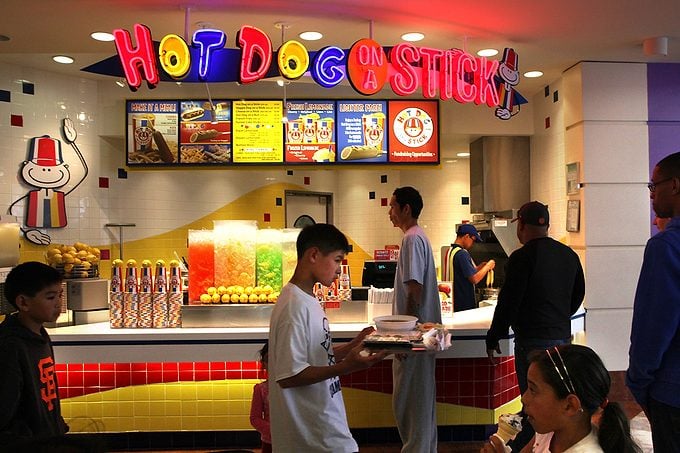
Hot Dog on a Stick started on Santa Monica’s Muscle Beach in 1946 before finding its natural second home in shopping malls. By 1995, its striped uniforms, corn dogs and fresh lemonade were already food-court fixtures, and french fries had just joined the menu in 1994.
The corn dogs were dipped in batter and fried to order, but the lemonade provided even more of a spectacle. Employees made it by hand, using whole lemons and a rather vigorous stomping process right there behind the counter. I’m well-versed in the process because Hot Dog on a Stick would become my very first job a few years later, an experience that required me to wear the famously striped uniform and jaunty hat while greeting customers, “Hi, I’m Lindsay! How can I stick a smile on your face today?” It was a character-building time.
Sbarro
If there were a universal symbol of the food court in 1995, it might be an enormous slice of pizza on a greasy paper plate. Sbarro had begun as an Italian grocery store in Brooklyn in 1956, but its expansion into shopping malls transformed the company into something much bigger. By the 1990s, the red-and-green Sbarro sign had become part of the American mall landscape.
The pizza was displayed behind glass and sold by the slice, with cheese and pepperoni doing most of the heavy lifting. There were also baked ziti, stuffed pizza, stromboli and other Italian-American dishes for anyone willing to commit to utensils. But the slice was particularly well-suited to mall life: fast, cheap and substantial enough to fuel another hour of deciding whether you really needed the new Oasis CD. (Obviously, you did.)
Panda Express
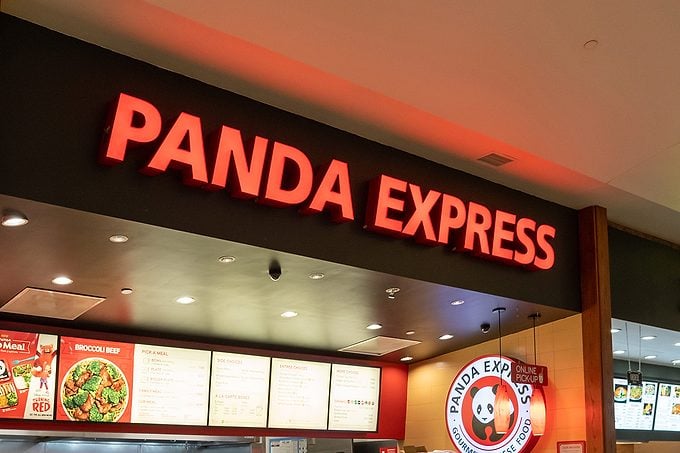
Panda Express didn’t merely live in mall food courts; it was created for one. Andrew and Peggy Cherng opened the first Panda Express at California’s Glendale Galleria in 1983, developing a faster, food-court-friendly version of their sit-down Panda Inn restaurant. By 1993, the chain had already grown past 100 locations.
And by 1995, orange chicken was firmly part of the equation. Chef Andy Kao developed the sweet, tangy chicken in 1987, and it would eventually become Panda Express’s signature dish. A plate piled high with orange chicken, chow mein and fried rice was more substantial than a pretzel or a slice of pizza.
Cinnabon
You didn’t even need to see Cinnabon to know the mall had one. The smell usually reached you first.
The chain opened its first bakery at Seattle’s SeaTac Mall in 1985, and a decade later, Cinnabon and the American shopping mall were thoroughly intertwined. By April 1995, the company had 278 bakeries, most of them in malls.
The menu revolved around the enormous iced cinnamon roll that made the chain famous. Back then, it sold for $1.80 to $1.99. It was the sort of thing you could buy as a snack and then spend 20 minutes dismantling with a plastic fork.
Auntie Anne’s
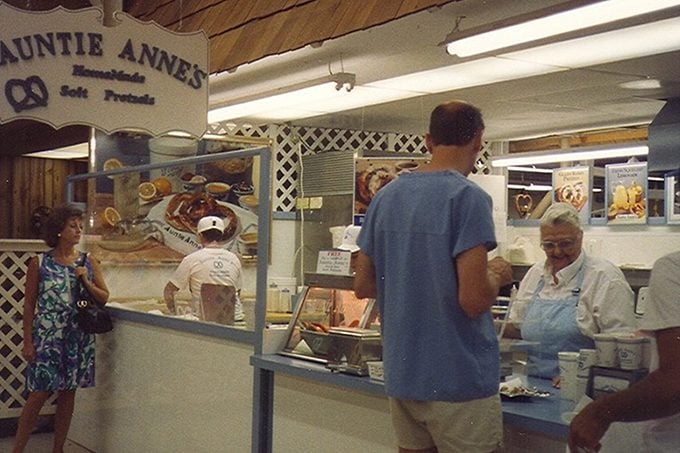
Auntie Anne’s was still relatively new in 1995. Anne Beiler had started selling pretzels at a Pennsylvania farmers market in 1988, but the business expanded remarkably fast: By 1991, there were already 90 locations in 12 states, and by the end of 1995, there were 344.
That made Auntie Anne’s a formidable newcomer to a mall snack category that already had an established name in Hot Sam, which had been selling pretzels in malls since the ’60s. But Auntie Anne’s had its own formula: soft, chewy pretzels baked hot, dipped in butter and sold in flavors like garlic, sesame and Glazin’ Raisin. A 1995 Los Angeles Times writer called it a “hot mall franchise,” which was becoming increasingly difficult to argue with.
TCBY
Frozen yogurt was practically made for the 1990s food court. It was cold, sweet and, crucially for a decade obsessed with cutting fat, could be presented as the sensible alternative to ice cream. TCBY had been capitalizing on that idea since opening its first shop in Little Rock, Arkansas, in 1981, and by 1995, brand recognition had reached an astonishing 74%.
The low-fat promise was such a familiar part of the culture that Seinfeld had already devoted an entire episode to a supposedly nonfat frozen yogurt shop—and the suspicion that something tasting that good couldn’t possibly be as virtuous as advertised. TCBY leaned into the same prevailing wisdom with the slogan “All of the pleasure, none of the guilt.” In a year when fat-free SnackWell’s cookies could inspire near-religious devotion, the popular frozen yogurt fit right in.
Mrs. Fields
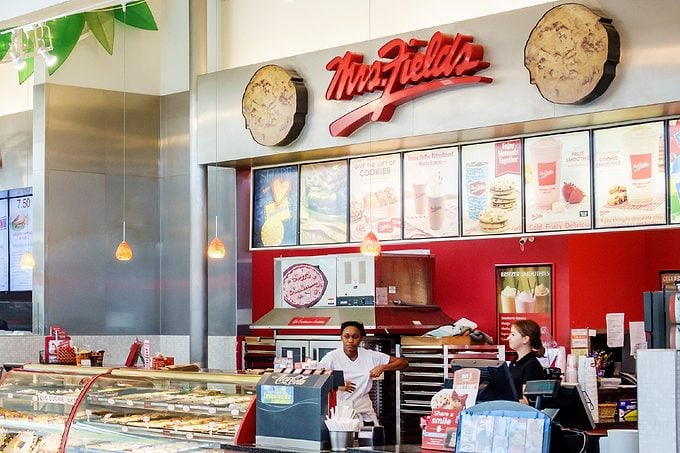
Debbi Fields opened her first cookie shop in Palo Alto, California, in 1977, and the business grew rapidly through shopping malls during the 1980s. By 1995, the company had hundreds of stores across the country, many of them in malls. The appeal was obvious: big, soft cookies baked fresh throughout the day and sold warm, often while the smell did a fair amount of the advertising.
For anyone who spent the decade wandering a mall with a warm chocolate chip cookie in one hand and a Claire’s bag in the other, the red Mrs. Fields sign was very much a part of the scenery.
Dippin’ Dots
Few foods looked more futuristic in 1995 than Dippin’ Dots. Invented by microbiologist Curt Jones in 1988, the tiny flash-frozen beads had found a natural home in malls by the early ’90s. The novelty caught on quickly: Sales increased more than 1,300% during the first half of the decade, and by 1995, there were more than 150 Dippin’ Dots outlets in 33 states.
The company called its creation the “Ice Cream of the Future,” which was a perfect fit for the moment. This was the era of color-changing drinks, tongue-staining candy and battery-powered lollipops. Food wasn’t merely supposed to taste good; it was increasingly expected to do something. In the year of Windows 95 and the first PlayStation, even dessert was getting a technological upgrade.
Gloria Jean’s
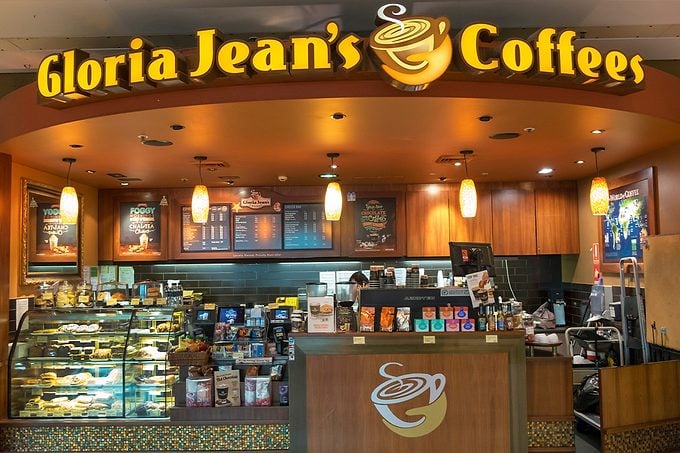
Before Starbucks conquered every corner, Gloria Jean’s was the coffee shop of the American mall. Gloria Jean Kvetko founded the company outside Chicago in 1979, and it grew rapidly as Americans developed a taste for specialty coffee. By 1993, Gloria Jean’s had nearly 225 stores and had become particularly associated with shopping malls.
For teenagers, Gloria Jean’s also offered the opportunity to walk around the mall holding a coffee drink and looking considerably more adult than they were. As someone who spent much of the ’90s pursuing roughly the same goal, I respect the commitment.
What was your favorite food-court stop? Let us know in the comments below!

