



We tested Quince’s affordable ceramic nonstick cookware to see how it compares to premium brands like Caraway and All-Clad, and whether it’s worth buying.
Our editors and experts handpick every product we feature. We may earn a commission from your purchases.
Learn more.
Quince is more than a lumpy, pear-shaped fruit. It’s also the buzzy brand known for making everything from cashmere and luggage to lab-grown diamonds and home goods feel a whole lot more affordable. And now, it’s coming for your cookware cabinet.
Quince recently launched a surprisingly affordable line of ceramic nonstick pots and pans, and we couldn’t help but want to take a closer look. For home cooks, finding cookware that performs well without costing a small fortune can be a challenge. So, when we spotted a Quince ceramic frying pan that looked remarkably similar to one of our all-time favorite Caraway pieces, but cost less than half as much, we were intrigued.
After putting it to the test, here’s how Quince’s ceramic cookware actually performs and whether it’s a budget-friendly alternative worth adding to your kitchen.
Quince Ceramic Fry Pan
A 12-inch nonstick fry pan that rivals high-end competitors.
What is Quince cookware?
Quince has officially entered the cookware scene, with ceramic nonstick, stainless steel and stainless-steel nonstick options now in the lineup. For this review, we tested the ceramic nonstick 12-inch frying pan, a roomy, everyday pan designed for everything from eggs and pancakes to sautéed veggies.
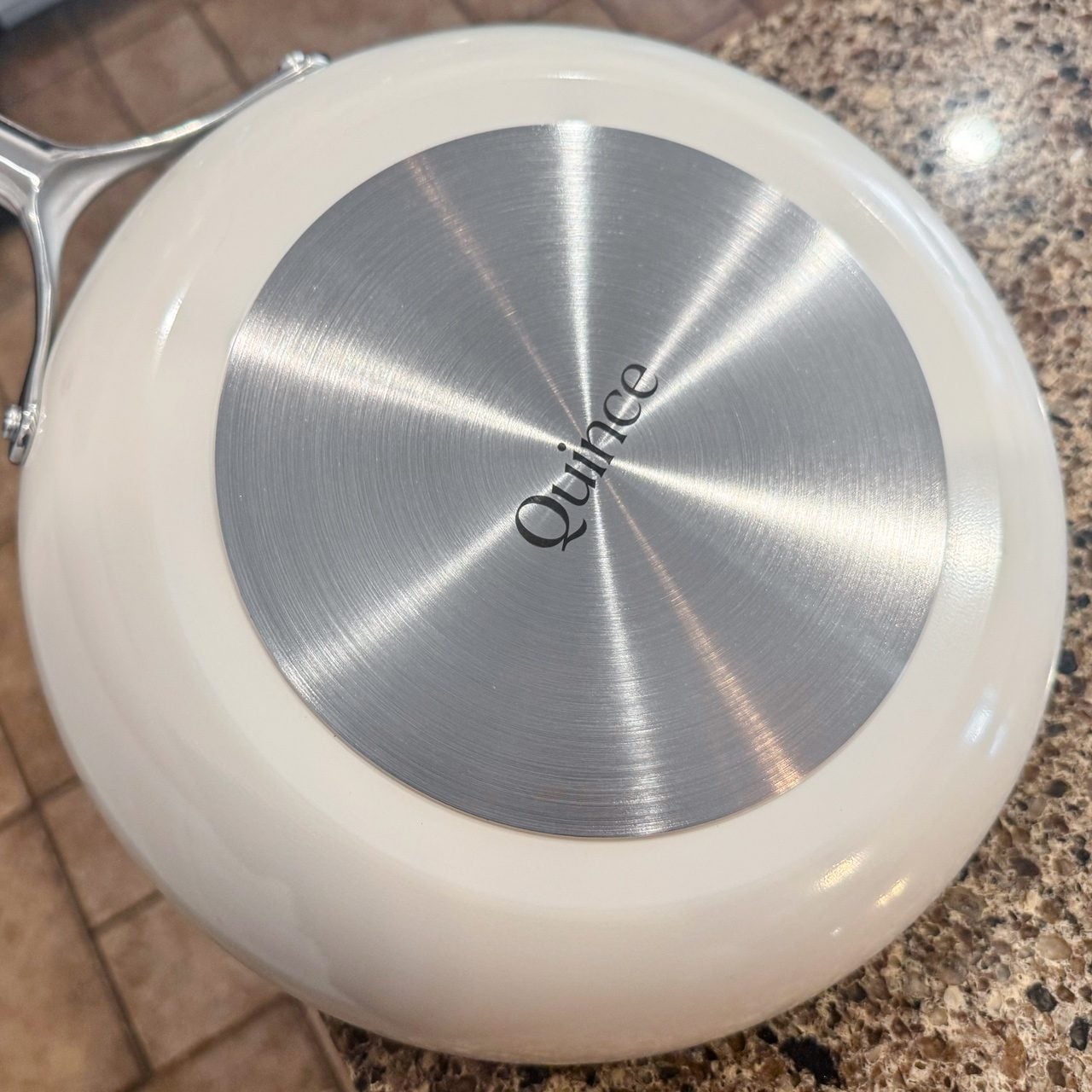
The pan has an aluminum body, a stainless-steel induction base, and a stainless-steel handle. Its ceramic coating is free of PTFE, PFOA, cadmium and lead, and it’s designed to work on all stovetops, including induction. It’s also oven-safe up to 500 degrees, so you can take food from the stovetop to the oven without transferring.
As for the cooking surface, Quince says the ceramic coating is designed to distribute heat evenly, helping food cook consistently from the center of the pan all the way to the edges. And because it’s nonstick, cleanup should be about as painless as it gets for cookware.
How We Tested It
I rely on nonstick cookware for quick, easy, toddler-friendly meals. Sautéed broccoli, chicken quesadillas, eggs, pancakes and rice are all regulars in my kitchen, and when dinner needs to happen fast, a reliable nonstick pan is hard to beat.
Appearance and Design
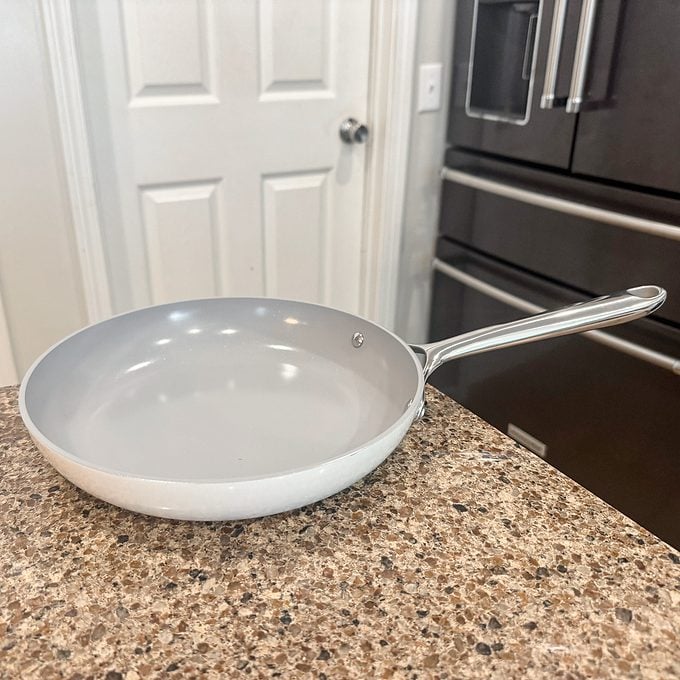
When I unboxed the Quince pan, the first thing I noticed was its familiar gray, sparkly ceramic interior—the same look you’ll find on popular ceramic cookware from brands like Caraway and Our Place. The ivory exterior gives it a clean, polished appearance, too.
The pan is lightweight without feeling flimsy. It has a stainless-steel bottom and a long stainless-steel handle, but it’s still easy to lift, maneuver and carry from the stovetop to the plate. That lighter weight also makes cleanup a little easier.
Cooking

The Quince pan went straight to work the night I unboxed it. First up: a chicken-and-cheese quesadilla and Spanish rice, aka a two-year-old-approved dinner.
Tortillas can be surprisingly finicky. Without oil, they tend to grab onto a traditional stainless-steel pan, while a good nonstick surface lets you cook with little to no oil, a major plus when I’m trying to keep meals from getting unnecessarily greasy.
Rice can be equally troublesome. When cooked over high heat, wet rice tends to stick to the bottom of the pan, which is why I like using nonstick cookware when I’m making a small portion quickly on the stovetop. (For bigger batches, I usually reach for a rice cooker, although that just means another thing to clean.)
The Quince pan had no trouble with the rice. Even after simmering without much stirring, not a single grain stuck to the bottom. Success.
I also tested fried eggs, pancakes and broccoli, and all three cooked quickly with minimal mess. A quick rinse between foods was often all the cleanup the pan needed.
The only food that left behind a bit of residue was a fried egg I made without any oil. It cooked and flipped semi-successfully, but it did stick to the pan a bit. While the yolk was left intact, the egg looked less than perfect. To be fair, I use a tiny bit of oil even with my favorite nonstick pans when frying eggs. Fried eggs are delicate; scrambled eggs, on the other hand, slid right out of the Quince pan with zero fuss.
Cleaning

For deeper cleaning (beyond a quick rinse and wipe), handwashing with warm, soapy water and a soft sponge or cloth is all you need. There’s no reason to attack a nonstick pan with aggressive scrubbing, which is good news for both the coating and your patience.
If something does manage to stick, Quince recommends simmering soapy water over low heat, then gently loosening the residue with a non-abrasive sponge.
There are a few care instructions worth keeping in mind. The pan is hand-wash only, not dishwasher safe, and consistent high-heat cooking can shorten the life of the nonstick coating. Metal utensils can also scratch ceramic, so I stick with wooden or other non-metal utensils.
You’ll also want to let the pan cool completely before rinsing it with cold water. Rapid temperature changes can cause the cookware to crack.
Like other ceramic cookware with an aluminum core, the Quince pan may not distribute heat quite as effectively as heavier cookware made from materials like stainless steel or cast iron. That’s worth considering if you frequently use your pans for high-heat searing or deep browning. Ceramic cookware isn’t really made for that.
Other Considerations

Ceramic cookware experts agree that construction matters just as much as the coating itself.
Alex Langdon, who runs the food blog The Candid Cooks with his wife, says, “The biggest thing I look for in a ceramic frying pan is a thick base and solid construction,” noting that he prefers pans with a stainless-steel body or base plate. Because ceramic coatings are brittle, he explains, warping or denting can cause the coating to crack.
Adam Gallagher, recipe creator and co-founder of Inspired Taste, similarly looks for a thick, heavy base. A substantial base helps distribute heat more evenly and minimizes those dreaded hot spots that leave one part of your food scorched while another is barely cooked.
The coating itself matters, too. “A smooth, even finish (not bumpy or textured) tends to release food more reliably and lasts longer before it starts to stick,” Gallagher says. He also advises taking “scratch-proof” claims with a grain of salt. Even durable ceramic coatings can wear down when exposed to metal utensils, so if a cookware set includes metal tools, that’s something to consider before buying.
And if oven cooking is important to you, always check the maximum oven-safe temperature before purchasing. One advantage of ceramic nonstick over traditional nonstick is that it can typically go in the oven, but that benefit disappears if the pan has a plastic handle. Langdon recommends looking for cookware with a metal handle if oven use is on your list.
Pros
- High-performing ceramic cookware with a premium feel
- PTFE- and PFOA-free
- Compatible with all stovetops, including induction
- Oven safe up to 500°F
- Lightweight and easy to lift, maneuver and clean
- Very affordable
Cons
- Hand-wash only
- High heat can shorten the life of the nonstick coating
- Butter and oil are fine, but oil sprays and aerosols should be avoided
- No lid included
- Limited color options
Comparison: Quince vs. Caraway vs. All-Clad
When it comes to ceramic nonstick cookware, Caraway consistently lands near the top of the list. Like GreenPan, Our Place and the Quince pan we tested here, it’s free of certain chemicals of concern. And, as with virtually all ceramic cookware, high heat is a no-go: It can gradually wear down the nonstick coating. In other words, we’ve yet to find a ceramic pan that delivers truly slick nonstick performance and can handle the kind of high heat you want for a serious steak sear. For that job, we’re still reaching for cast iron.
Put the Quince 12-inch frying pan next to Caraway’s 12-inch Large Fry Pan, and you’d be forgiven for doing a double take. The two look remarkably similar, right down to their overall shape and color. Our product testing team previously named Caraway’s fry pan the “most stylish” in our roundup of the best ceramic cookware, so it’s safe to say Quince earns a 10/10 for looks, too.
There are a few notable differences. Caraway’s pan is oven-safe up to 550 degrees and comes in eight colors, while Quince keeps things simple. Most importantly, Caraway’s pan costs more than twice as much as Quince’s.
If longevity is your top priority, All-Clad is another brand worth considering. Editor Emily Way tested the 10- and 12-inch NS Pro fry pans and was impressed by their durability. Unlike traditional nonstick cookware, the NS Pro pans feature a protective ceramic plasma layer designed to improve food release and extend the coating’s lifespan. All-Clad also offers the HA1 Expert and Essentials nonstick lines; according to an All-Clad spokesperson, the NS Pro line is its closest comparison to HexClad.
Of course, All-Clad comes with a considerably higher price tag. Its cookware is more in line with Caraway pricing, while Quince is still the clear budget winner of the three. That said, our editors have found All-Clad cookware to be a worthwhile investment for cooks who prioritize durability. These are pans designed to last.
Final Verdict
If you’ve been eyeing premium nonstick cookware from brands like Caraway, Our Place or All-Clad but can’t quite justify the price, Quince makes a compelling budget-friendly alternative. It delivers impressive nonstick performance and a quality-to-price ratio that’s hard to ignore.
I’d recommend the Quince fry pan to anyone building out a kitchen from scratch, as well as seasoned home cooks who appreciate a good deal. It heats quickly, works across stovetops and in the oven, and cleans up easily. Most importantly, it delivers the slick, reliable nonstick performance you want from an everyday frying pan.
Where to Buy
Quince Ceramic Fry Pan
An affordable nonstick pan with impressive performance capabilities.
You can shop Quince’s 12-inch ceramic frying pan for just $55, while the 8-inch version costs $45.
Want more than one? A three-pan set is $120, and the seven-piece ceramic nonstick cookware set is an especially impressive $200. For the quality and performance, those prices are tough to beat.
FAQ
Is Quince ceramic cookware good?
We think so! Quince ceramic cookware is an affordable, high-value option with impressive nonstick performance. It’s also oven safe up to 500 degrees.
Is Quince cookware a good brand?
Yes. Quince offers strong performance at a fraction of the cost of premium brands like Caraway and All-Clad. That said, some reviews of Quince stainless steel cookware mention sticking and uneven cooking.
What is the downside of ceramic cookware?
Ceramic nonstick cookware is generally less durable than traditional stainless steel or cast iron, with coatings that can wear out within one to three years. High heat can speed up that wear, so lower temperatures and careful use are best. Most ceramic nonstick pans are also hand-wash only. I’ve personally found them to last a little longer with careful use and sticking to low temps.
Why You Should Trust Us
Our testing team has years of experience evaluating cookware, from ceramic pans to cast iron skillets and everything in between. Many of our editors have professional kitchen or culinary backgrounds, while others are passionate home cooks committed to honest, hands-on testing.
For this review, Editor Mary Henn tested the Quince ceramic frying pan in her home kitchen for several weeks. She also consulted food bloggers Alex Langdon of The Candid Cooks and Adam Gallagher, recipe creator and co-founder of Inspired Taste, about what to look for in quality ceramic nonstick cookware.

