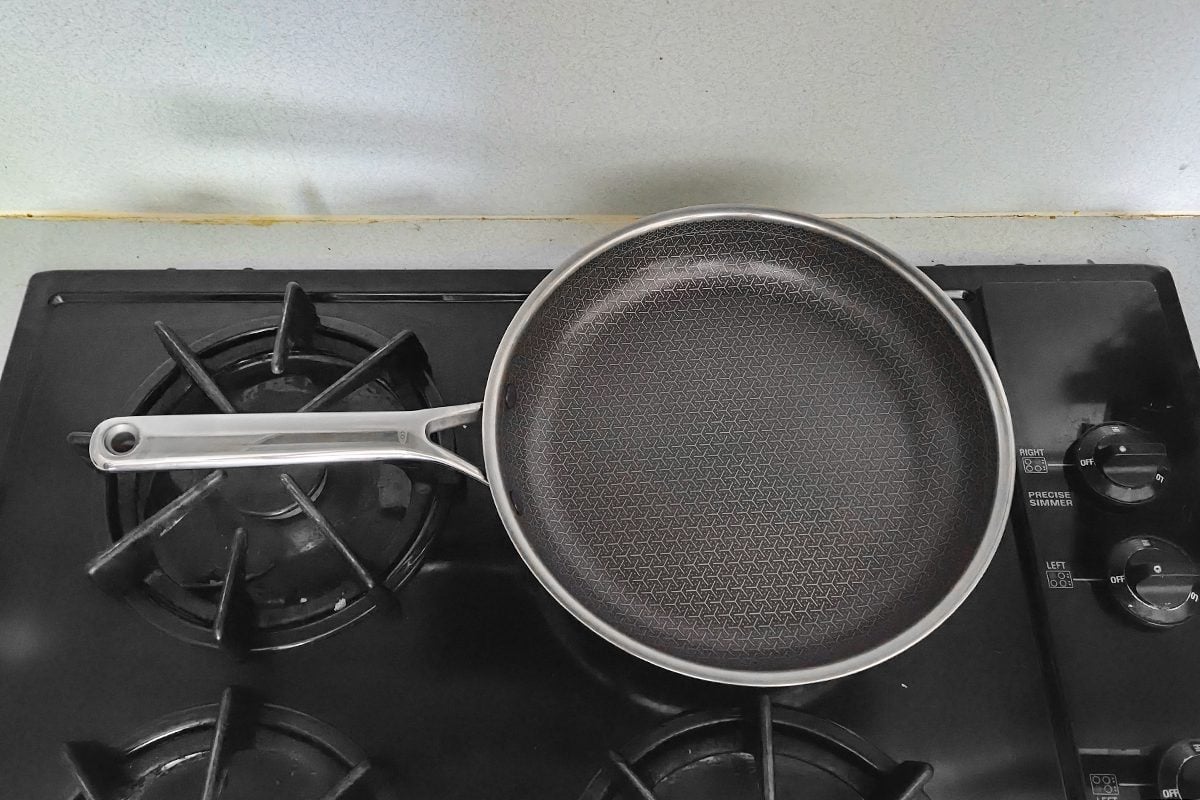
The OXO Trident hybrid frying pan feels like the leading luxury hybrid cookware—and costs half the price.
Our editors and experts handpick every product we feature. We may earn a commission from your purchases.
Learn more.
A few years ago, colorful ceramic cookware was all the rage. While we still love our Caraway and Our Place cookware, these non-toxic pans aren’t exactly known for their longevity. Like traditional nonstick, ceramic requires a little care to stay slick for several years: no spins in the dishwasher, no high heat and absolutely no metal tools. But even with careful handling, the ceramic coating slowly wears down over time. That’s why many folks are turning to hybrid cookware.
When I heard that one of my favorite budget brands was launching its own line of hybrid cookware, I knew I had to give it a try. Here’s my experience testing out the new OXO Trident Hybrid Frying Pan as a humble home cook with a bias towards “buy-it-for-life” products.
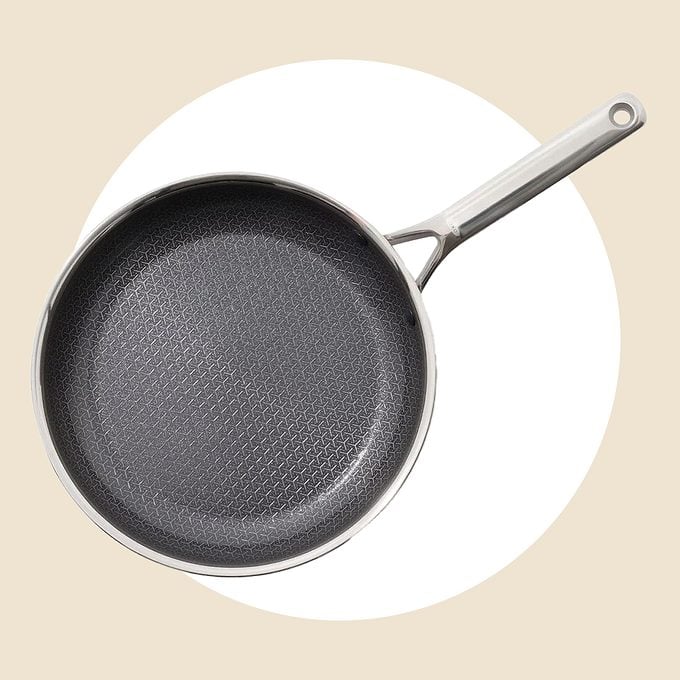
OXO Trident Hybrid Frying Pan
Made with non-toxic ceramic covered by a stainless steel grid, the new OXO hybrid frying pan is ideal for searing, braising and sauteing.
What is OXO hybrid cookware?
The Gordon Ramsay-approved HexClad pan is tbe most popular option when it comes to hybrid cookware. For good reason, too, given its incredible performance according to several editors. But lately, lots of other brands—such as Greenpan—are getting into the game, and most are available at just a fraction of HexClad’s high price point.
So, what exactly is hybrid cookware?
Much like the editor-loved HexClad skillet, the OXO Trident Hybrid Frying Pan follows this pattern. It features a hybrid construction with a nonstick surface and a stainless steel grid pattern. The exterior is composed of a solid stainless steel layer, which helps the pan heat evenly. While OXO uses non-toxic ceramic as its nonstick layer, this particular coating is diamond-infused and safe for use with metal utensils, adding to its longevity.
How We Tested
My OXO hybrid skillet arrived packaged in a plain brown box. Inside the box, the pan was wrapped in a plastic sleeve for protection. While it doesn’t have any flashy packaging like HexClad, it arrived completely scratch- and dent-free. After washing it with a bit of dish soap and a soft sponge, it was ready to sear up some home-cooked meals.
Pan Frying

In my humble opinion, breakfast is the best meal of the day. It’s also one of the trickiest to perfect. My first test for the OXO Trident frying pan was simple: how well can this pan handle hash browns and eggs? Eggs are notoriously sticky, making them the perfect challenge. Similarly, hash browns take a long time to crisp up, especially on nonstick surfaces that typically require lower heat settings.
I began by preheating the pan over medium heat, then adding a small amount of vegetable oil and a layer of shredded hash browns. I let the hash browns cook for about seven minutes on each side before turning them. Unlike my past attempts on my nonstick pans, the hash browns were actually browned, rather than sad and pale (or worse, charred).
After impressing me with its pan-frying power, I had to see how this hybrid pan handles over-easy eggs. I turned the temperature down to low and didn’t add any additional oil in order to give the pan a chance to wow me. And wow me it did! My egg cooked quickly and efficiently, even getting a layer of crispy lacy goodness on the edges. Flipping it was surprisingly simple, too. A quick turn with my nylon spatula was all it took to release the egg. There was nary a speck of egg white stuck anywhere.
Dare I say that this was the best breakfast I’ve ever made? Yes. Breakfast fans like me will be seriously impressed by the pan’s performance.
Searing

While I appreciate the pan’s nonstick properties, the real test for me is its searing power. Ceramic and traditional nonstick pans—handy as they are—don’t pair well with high-heat cooking. That means meats won’t get that perfectly charred crust that takes them to the next level. However, the OXO pan can handle high heat—up to 850ºF in the oven, in fact. I put it to the test by browning some shrimp for a stir-fry.
I preheated the pan on medium-high heat with a little butter and vegetable oil. As with other ceramic pans, you’ll want to avoid cooking sprays, as the polymers can adhere to the surface and cause a permanent, unpleasant stickiness. After defrosting some shrimp under running water, I patted them dry and seasoned them with salt and pepper before popping them into the Trident pan.
The shrimp didn’t take long to turn pink, but I let them cook a little longer on both sides to see how crispy I could get them. Overall, I’m impressed! It took almost no time at all to get a nice, golden brown crust on both sides. I’ve only seen stainless steel pans sear this well, though going that route risks sticking. Thanks to the clever grid pattern, that’s not an issue for the Trident pan.
And the best part? It’s totally safe to pop into the dishwasher—but cleaning it by hand is just as quick.
Safety
While I’m sold on the OXO Trident pan’s performance, I also wanted to check in with an expert for their perspective on what to look out for when hunting down the best non-toxic hybrid cookware. According to Sabai Co-founder and plastic detox expert Phantila Phataraprasit, there are several things to keep in mind when hunting for healthy hybrid cookware. She recommends researching:
- What the cooking surface is made of
- Third-party testing to confirm it is free of PFAS and other heavy metals
- Heat tolerance
- California AB 1200 disclosures
OXO’s cooking surface is made of non-toxic ceramic and is free of PFAS. It’s also not included on OXO’s disclosure page, meaning that there are no harmful chemicals intentionally added. The cookware is also oven-safe up to 850ºF, making it a safe choice for braising.
That said, OXO doesn’t publish information on its testing practices, so we couldn’t verify if it’s third-party tested. We recommend sticking with stainless steel (no pun intended) if you want to ensure your cookware is 100% free of chemicals. IKEA stainless steel cookware is a good budget-friendly option. I also love the splurgy stainless steel cookware from Cookware 360.
Pros
- Nonstick surface performs like stainless steel, without the sticking
- Very inexpensive compared to similar brands
- Compatible with metal utensils
- Dishwasher-safe
- Heats evenly
- Zero PFAS
- Oven-safe up to 850ºF
Cons
- Not compatible with cooking sprays
- A bit hefty
Comparison: OXO vs. HexClad

As previously mentioned, the OXO Trident hybrid frying pan is most closely comparable to the HexClad hybrid frying pan. I own both, so I examined them side-by-side. While they look very similar, there are a few key differences between the two:
- The HexClad pan offers a hexagonal pattern, while the OXO pattern is closer to a Y-pattern.
- HexClad’s grid pattern extends to the exterior of the pan, while the OXO pan has a solid stainless steel exterior.
- OXO hybrid pans are oven-safe up to 850ºF, while HexClad pans are oven-safe up to 900°F.
- The OXO pan weighs around 1.15 pounds, while the HexClad pan is a bit heftier at 2.45 pounds.
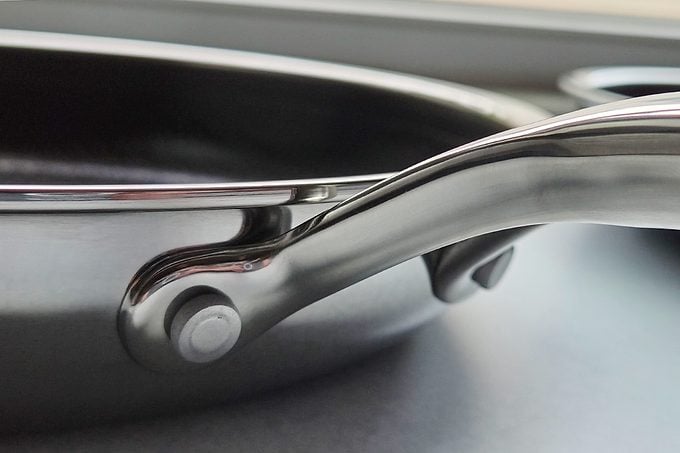
- Both options have a stay-cool stainless steel handle, though the HexClad version curves a bit more.
- Both pans are free of PFAS and offer nonstick properties.
- Both pans come with a lifetime guarantee.
The biggest discrepancy, however, is the price point. While the OXO Trident rings up at around $80, the HexClad version costs $149 without promotions or discounts. That’s a difference of about $70, making the HexClad pan nearly twice the price of the OXO version.
Final Verdict
Taste of Home editors are already big fans of OXO products, having tested kitchenware like the brand’s coffee grinder, coffee concentrate maker, produce keepers, adjustable measuring cup and nonstick frying pan in the past. OXO hybrid cookware is no exception. It’s easy to care for, uses high-quality materials that should last a long time and doesn’t break the bank. For folks who want to try out HexClad cookware but don’t want to commit to the high price point, the OXO Trident line is a good litmus test to see if hybrid cookware is right for your family.
After using the pan consistently for over a month and cooking dozens of dishes, it still looks brand new and performs as well as it did during my first test run. The Trident pan has quickly become my go-to skillet for fuss-free meals, usurping even my beloved Circulon pan. I’ll continue using the skillet regularly and update this piece with any new developments. But for now, you can say I’m a hybrid pan fan.
Where to Buy
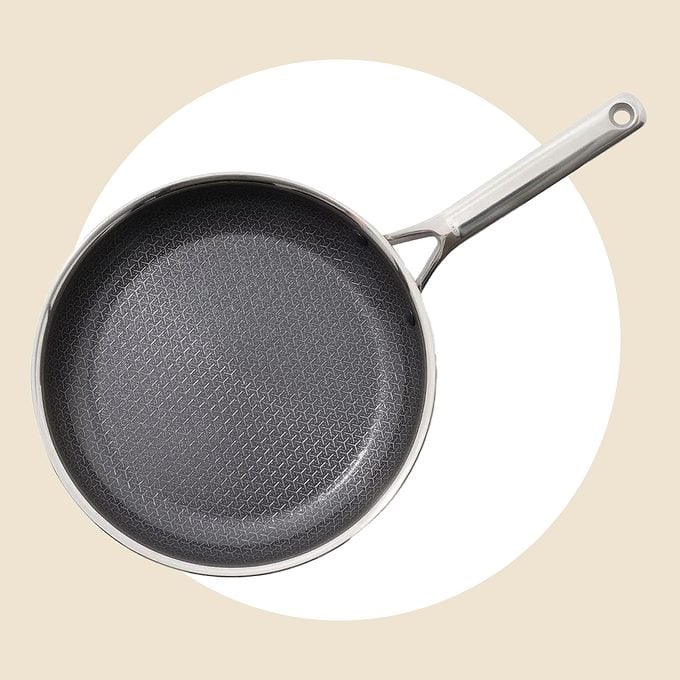
OXO Trident Hybrid Frying Pan
The OXO frying pan works similarly to luxury brands like HexClad—and it's nearly half the price.
The OXO Trident Hybrid Frying Pan retails for around $80 for the 10-inch version. There’s also eight-inch and twelve-inch versions for folks who want more flexibility with their serving sizes. In addition, OXO offers several other cookware options in its new Trident line, including a lidded wok, a saucepan and a full cookware set. Those looking to try out hybrid cookware will appreciate this low-fuss pick for their favorite stovetop staples.
FAQ
Is OXO a good brand of cookware?
According to our tests, OXO hybrid cookware is a fantastic pick for home cooks on a budget. In addition, we’ve tested other OXO offerings many times in the past and consistently come away impressed. Some of our favorite OXO kitchenware includes the brand’s coffee grinder, coffee concentrate maker, produce keepers, adjustable measuring cup and nonstick frying pan.
Is OXO cookware non-toxic?
As with other ceramic cookware brands, the ceramic nonstick coating in OXO’s Trident line is non-toxic. It’s also diamond-infused and safe for use with metal utensils, unlike the ceramic nonstick coatings used in most other cookware.
Can OXO cookware go in the oven?
Yes! A distinctive feature of the OXO Trident Hybrid line is that it’s oven-safe up to 850ºF without a glass lid.
Why You Should Trust Us
As Shopping Editor for Taste of Home, I’m a passionate home cook with a passion for recommending the very best products using honest and fair testing practices. Our testing team has a combined decade of experience testing and evaluating everything from the best upright freezers to the best toasters.
I’ve personally tested dozens of cookware brands, including ceramic cookware, nonstick cookware and stainless steel cookware. While I’m not a pro chef, I always approach testing from a home cook’s perspective—especially when it comes to personal budget. This gives me a unique perspective on finding the best kitchenware for the average household chef. As a rule of thumb, bells and whistles don’t impress me as much as items that withstand the test of time!
For this piece, we also spoke to Phantila Phataraprasit, Sabai‘s co-founder and plastic detox expert, for her perspective on hybrid cookware.