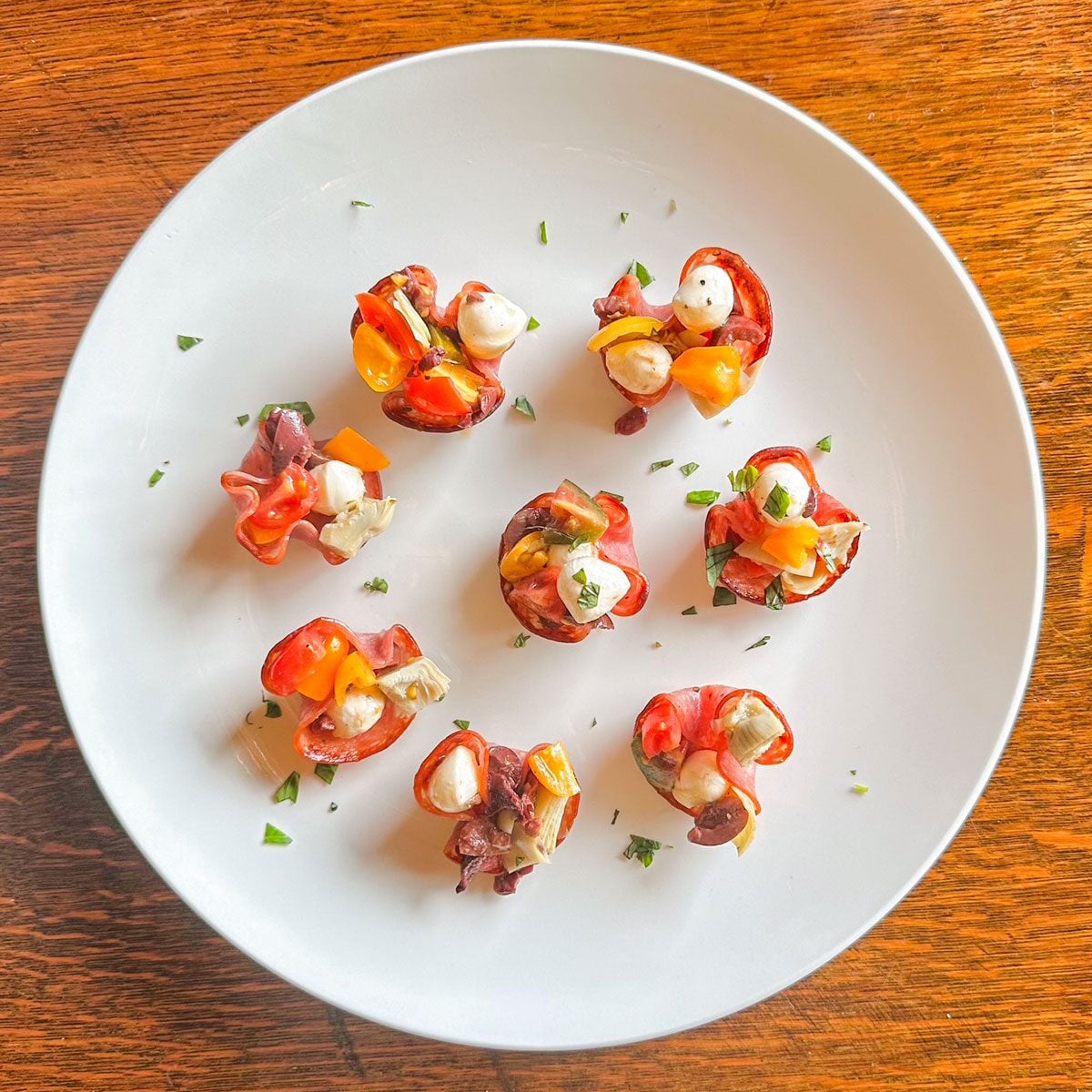
These mini salami charcuterie cups work better with this specific adjustment.
Salami is a staple in my house. When we run out, it doesn’t go unnoticed—mostly because it’s part of my kids’ favorite after-school snack. My husband grew up calling the snack “ghost crackers,” and somehow that’s the name that stuck. No one—including my mother-in-law—has ever been able to explain why. They’re simple: saltines with a generous swipe of cream cheese and a slice of salami on top. My kids make them almost every day, so we always keep a pack of salami on hand.
When I started seeing salami pressed into muffin tins and baked into little “cups” for antipasto fillings, I had to try it for myself. It’s like taking all the best parts of a charcuterie board and turning it into a handheld appetizer. They turned out almost perfectly, so I adjusted one thing, and now I can’t get enough of them.
What are the viral salami cups?

They are, quite literally, cups made out of sliced salami. You press the slices into a muffin tin and bake at 400°F for six to eight minutes. As they heat, the fat renders, the edges curl, and the slices firm up enough to hold a cup-like shape.
Most of the videos I saw used a standard muffin tin, so that’s where I started. My tins are a true standard size, and I tried two brands of salami—Gallo and Primo Taglio. The slices were nearly identical in size, and both came up short. Pretty quickly, I realized they weren’t quite large enough to climb the sides and make a proper bowl shape. Instead of forming cups, they settled into flatter, almost frisbee-like shapes. Not a total loss, but not really the goal. Of course, you could use larger salami slices, but then you lose the one-bite appeal entirely.

I switched to a mini muffin tin for the next round, and that made all the difference. The smaller wells gave the salami somewhere to go, so the edges lifted and held. The shape was closer to what I’d seen online, with a slightly wavy edge that looked intentional instead of accidental. More importantly, they actually functioned like cups—something you could spoon into, not just pile onto.
For the filling, I kept things simple: chopped kalamata olives, tomatoes, pearl mozzarella, artichoke hearts, a little oil and vinegar and fresh basil. Basically, everything I’d want on an antipasto platter, just packed into a smaller package. And in the mini cups, it all stayed neatly contained, rather than sliding off the edges.
How do they taste?

The texture is the first thing you notice. The cups don’t shatter the way a cheese crisp would—there’s enough fat in the salami that it stays a bit flexible—but they do firm up enough to hold their shape and support a filling without collapsing. That texture plays out differently depending on the size too. The larger versions felt a bit clunky to eat in one bite, while the mini cups were more proportional and easier to handle.
Flavor-wise, they’re salty, savory and rich, which makes them a good base for anything bright or briny. My antipasto mix worked well, but it’s easy to see this going in a lot of directions. Creamier cheeses, different herbs and even something with a little crunch for contrast would work.
I wouldn’t swap them for a full charcuterie spread, but as a way to repackage the same flavors into something a little more contained, they’re a fun option. And at the very least, salami cups have given me a new way to rethink our usual ghost crackers!
Related: