


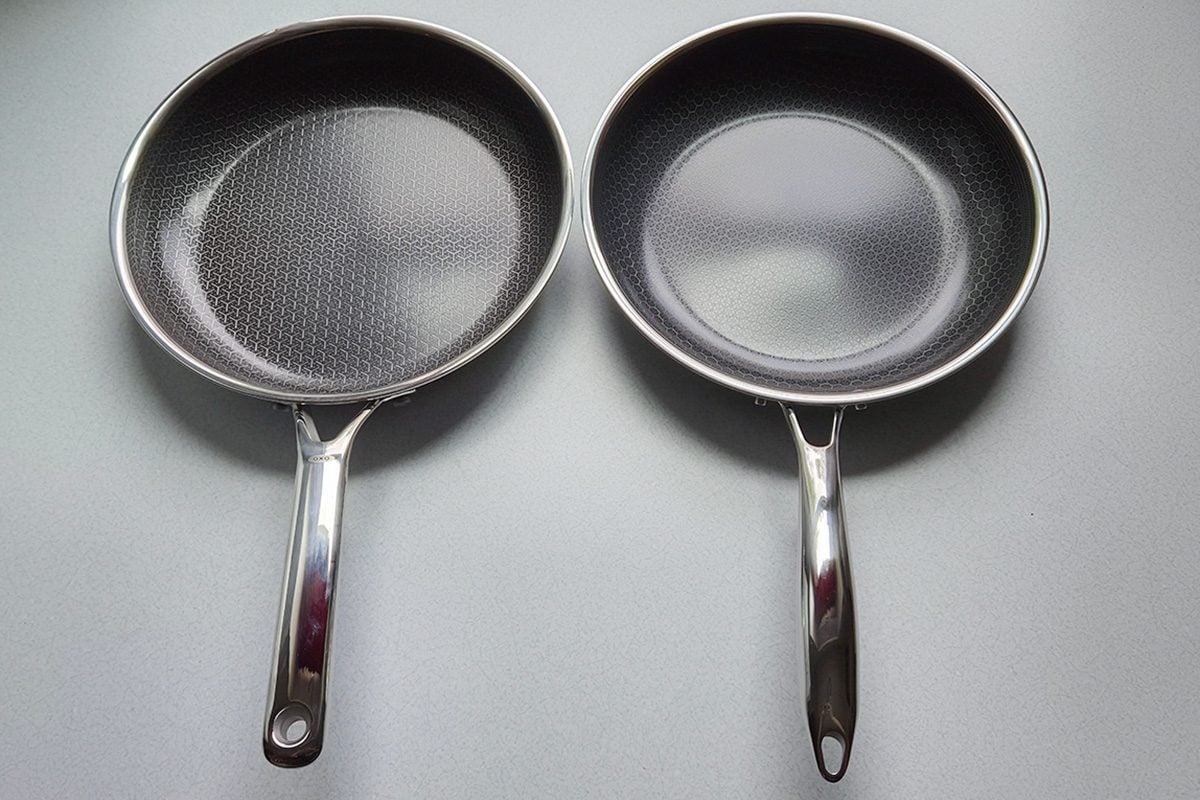

Should you splurge on pricey HexClad cookware or save with the OXO Trident line? We put both head-to-head to see which pan performs the best.
Our editors and experts handpick every product we feature. We may earn a commission from your purchases.
Learn more.
Interest in non-toxic cookware has soared in recent years, fueled in part by the popularity of ceramic cookware. This type of cookware retains the slippery properties of traditional nonstick cookware while also being free of “forever chemicals.” For ceramic cookware enthusiasts, hybrid pans are a fantastic addition to the kitchen. They offer the nonstick properties of ceramic paired with the searing power of stainless steel. Plus, unlike traditional ceramic pans, home cooks can use metal utensils on them since the raised steel patterns protect the coating from scratches.
“Hybrid cookware combines stainless steel with a nonstick surface. There are different constructions, but the most common newer designs use a tri-ply stainless steel base with a raised pattern of steel ridges on the surface and a nonstick coating between them,” says Sabai Co-founder and plastic detox expert Phantila Phataraprasit.
HexClad pans pioneered this construction, but dozens of brands now make their own hybrid cookware. OXO, an editor-loved brand, recently launched its own line of Trident hybrid cookware that mimics many of the features we love in HexClad pans. Given the brand’s good reputation—and a significant price difference—we just had to see whether these hybrid pans can stand up to the original HexClad pan.
So, in the head-to-head battle of HexClad vs. OXO, which comes out on top?
The Splurge: HexClad Hybrid Cookware
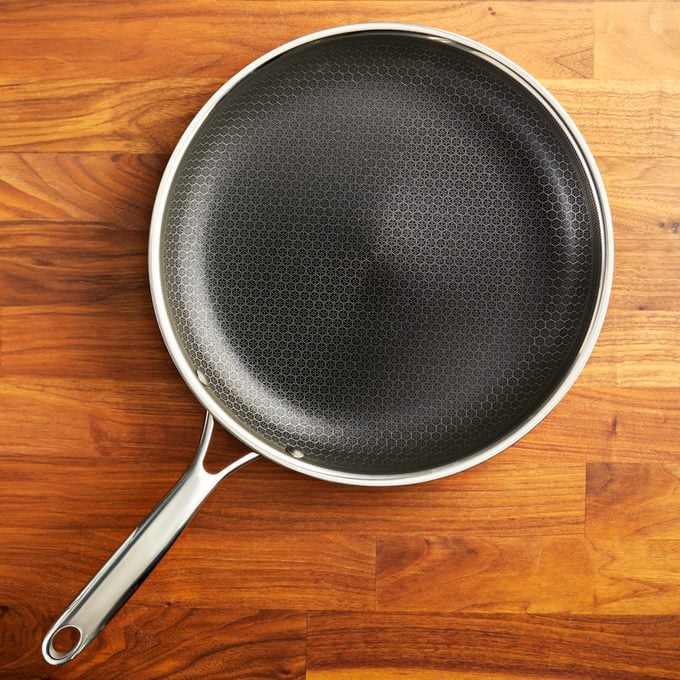
HexClad 10-Inch Fry Pan
Three of our editors own HexClad pans, and we’re all big fans of the brand—just check out our extensive review. There are a lot of things to love about HexClad pans, but some of our favorite features include an aluminum core for even heating, a near-perfectly nonstick surface and, of course, the absence of forever chemicals like PFAS.
Additionally, HexClad pans are oven safe, clean up in the dishwasher and are totally safe to use metal utensils with. They also boast a generous lifetime warranty that covers manufacturing defects. It even has the added benefit of being endorsed by Chef Gordon Ramsay. Editor Katie Bandurski has used her HexClad pan for the past two years and remains impressed by its performance.
“Most of my skillets have held up like a dream,” she says. “I have three, and only the small one has a noticeable scratch in the coating. They still perform beautifully for nonstick searing and high-heat cooking. Maintenance has been pretty simple, too. Occasionally, I need to scrub off some burnt-on marks with coarse salt, but it lifts away very easily. I’m still so pleased with this purchase and the pans’ longevity. I tell all my friends/family who are getting married to add HexClad to their registry!”
Pros
- Truly nonstick
- Heats evenly
- Oven safe up to 900ºF
- Dishwasher-safe
- Heats evenly
- Zero PFAS
- Induction compatible
- Safe for use with metal utensils
- Lifetime warranty
Cons
- Pricey
- Heavy
The Steal: OXO Trident Cookware
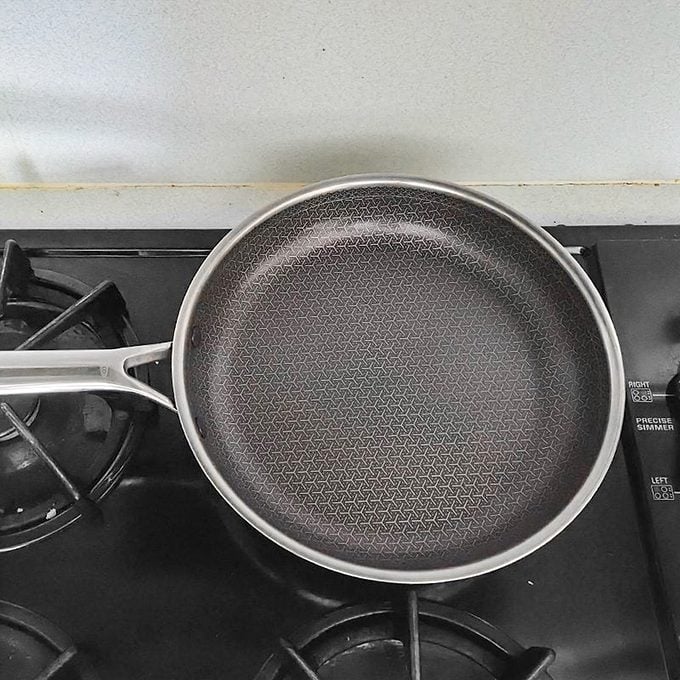
OXO Trident Hybrid Frying Pan
Made with non-toxic ceramic covered by a stainless steel grid, the new OXO hybrid frying pan is ideal for searing, braising and sauteing.
Like HexClad, the 10-inch OXO Trident hybrid pan offers the searing power of stainless steel, coupled with the nonstick nature of ceramic. I love using mine for searing shrimp and browning breakfast hash, which you can read more about in my review of the pan. Overall, I find it offers comparable searing power to stainless steel, but without the sticking. Plus, I don’t have to crank my heat up for a nice sear—medium works just fine for most dishes.
Similarly to HexClad, this pan boasts a hybrid build with an aluminum core and tri-ply construction. While it’s still rather heavy in my opinion, it’s also a bit lighter than the comparable HexClad pan. Additionally, it comes with a similar lifetime guarantee as HexClad, which provides protection against manufacturing defects.
Pros
- Nearly half the price of HexClad pans
- Nonstick surface
- Compatible with metal utensils
- Dishwasher-safe
- Heats evenly
- Induction compatible
- Zero PFAS
- Oven-safe up to 850ºF
- Lifetime Warranty
Cons
- A bit hefty, but more lightweight than HexClad
HexClad vs. OXO: The Bottom Line

Personally, I reach for my hybrid pans pretty equally. I really can’t pinpoint much of a difference in performance when it comes to searing, sautéing or braising. In fact, the pans are so similar that I only found a few differences during my use and research:
- Price: Probably the most significant difference between these pans is the price. The OXO pan rings up at around $80, while the HexClad version costs $149 without promotions or discounts.
- Pattern: HexClad pans offer a hex grid pattern, while the OXO pan is more of a Y-pattern. That said, I don’t notice much of a difference in nonstick performance.
- Handle: The HexClad pan offers a rounded handle, which I find a bit more ergonomic.
- Inner Structure: The HexClad pan seems to have a slightly less angular interior, though both pans are relatively rounded where the bottom meets the sides. This prevents buildup and makes them easier to clean and pour from.
- Oven Safety: While both pans are oven-safe, the OXO pan is oven-safe up to 850ºF, whereas the HexClad pan is safe up to 900ºF.
- Weight: The OXO pan weighs around 1.15 pounds, while the HexClad pan is a bit heftier at 2.45 pounds.
- Outer Material: Interestingly, the biggest cosmetic difference between the two pans is the material on the bottom of the pan. While HexClad pans continue the hex grid pattern along the bottom, the OXO pan offers a fully stainless steel bottom. Personally, I don’t notice much of an effect on performance, but I do find this aesthetic difference interesting.
As I mentioned, the 10-inch OXO Trident hybrid pan rings up at around $80, whereas the 10-inch HexClad hybrid pan costs $149 without promotions or discounts. That’s a difference of about $70, with the HexClad pan retailing for nearly twice the price of the OXO version. For this reason alone, I recommend trying out the OXO pan if you’re interested in hybrid cookware but don’t want to spend big on a pan you may not like.
That said, HexClad is still an excellent brand with a stellar reputation. It also offers so much more than just hybrid pans. Some of our favorite HexClad items include a workhorse Dutch oven, a top-rated knife set, a versatile griddle and the legendary HexClad pizza steel, which Deputy Editor Katie swears by. It’s also worth noting that HexClad offers frequent sales, including huge discounts on cookware bundles. When those deals roll around, it’s worth taking advantage of them if you’re in the market for high-quality kitchenware.
While OXO’s Trident line offers a few comparable options, it’s nowhere near as extensive as HexClad’s line of cookware. Plus, we have the added benefit of having tested HexClad for over two years, while the Trident line is too new to comment on its longevity. We’ll be sure to update this piece with any observations once we have over a year of testing under our belts.
Why You Should Trust Us
I’ve personally tested dozens of cookware brands, including ceramic cookware, nonstick cookware and stainless steel cookware. While I’m not a pro chef, I always approach testing from a home cook’s perspective—especially when it comes to personal budget. This gives me a unique perspective on finding the best kitchenware for the average household chef.
Katie Bandurski is our Deputy Editor and on-staff HexClad expert. To date, she has reviewed almost everything the brand has to offer, including skillets, a wok, a Dutch oven, a knife set, a pizza steel, a griddle and pepper mills. Her HexClad cookware reviews are thorough, honest and provide insight into how the products hold up over time.

