

Hawaii-born chefs explain the history, cultural influences and iconic dishes that define Hawaiian barbecue.
I’ve been eating Hawaiian barbecue since my first trip to Hawaii in 1999. Fresh out of college and on a family cruise vacation, I quickly discovered the joy of plates piled high with grilled meats, rice and macaroni salad. I’ve visited Kauai and Maui several times since and still seek out Hawaiian barbecue whenever I return.
What keeps drawing me back isn’t just Hawaiian food itself—it’s the way every meal reflects Hawaii’s unique history. Many mainland diners think of Hawaiian barbecue as a single cuisine, but every dish tells part of Hawaii’s story. Traditional Hawaiian foods, immigrant influences and generations of cultural exchange have all helped shape what appears on the plate today. That’s why a menu might include traditional dishes like lau lau and kalua pig alongside Korean-inspired kalbi ribs and Japanese-influenced mochiko chicken.
To better understand that story, I spoke with two chefs who were born and raised in Hawaii and have spent their careers celebrating Hawaiian food culture: chef Sheldon Simeon, a two-time Top Chef Fan Favorite finalist and author of Cook Real Hawai’i and ‘Ohana Style, and chef Philip “Ippy” Aiona, host of the Emmy Award-winning docuseries Eating Our Roots and author of Growing Up Hapa in Hawai’i.
What is Hawaiian barbecue?

The first thing both chefs told me was that “Hawaiian barbecue” isn’t the same thing as traditional Hawaiian food. “The term ‘Hawaiian’ is the confusing one,” Sheldon says. The food many Americans recognize as Hawaiian barbecue is the product of generations of cultural exchange, where Native Hawaiian traditions meet influences from Japan, Korea, the Philippines, Portugal, China and beyond.
Native Hawaiian cuisine was centered around local ingredients like fish, taro, sweet potatoes, breadfruit, seaweed and Hawaiian sea salt. Food was often prepared simply over a fire or steamed in leaves. Ippy says this simplicity served a purpose: The nutrient-dense dishes were designed to sustain an entire community.
Later, as sugar production expanded during Hawaii’s plantation era, immigrants arrived on the islands to work in the fields, bringing their culinary traditions with them. Over time, this created the multicultural food that Hawaii is known for today. “Food became a shared language,” Sheldon says.
How plate lunch became Hawaii’s ultimate comfort food
You can’t talk about Hawaiian barbecue without talking about plate lunch, the meal format that defines local Hawaiian food culture. The concept traces back to the shared lunches of plantation workers who gathered during their breaks to share foods and cooking traditions from their respective cultures. Those communal meals gradually evolved into plate lunch, now a staple on restaurant menus all across the islands.
A classic plate lunch includes a protein, two scoops of rice and a scoop of macaroni salad. The protein could be anything from kalua pig to teriyaki beef, chicken katsu or kalbi ribs.
Meet the imu: Hawaii’s original barbecue
Long before smokers and gas grills, Native Hawaiians cooked in an imu, an underground oven used to cook kalua pig and other foods. It remains one of the islands’ most important culinary traditions. “The imu is the cornerstone of traditional Hawaiian cuisine and can be thought of as Hawaii’s original barbecue,” says Ippy. The method is most closely associated with kalua pig. In fact, the word “kalua” means “to cook in an underground oven” in Hawaiian.
Building an imu is a labor of love. First, a large pit is dug in the ground. Lava rocks are placed at the bottom, and a fire is built upon the rocks (usually fueled by kiawe wood, a type of mesquite that grows in Hawaii). When they’re glowing hot, banana stalks and leaves are layered into the pit to add moisture and create steam. Meat and vegetables are added before everything is sealed underground to trap the heat, smoke and steam inside.
Sheldon says it can take 8 to 10 hours for the food to cook, so modern use of the imu is reserved for celebrations and special occasions. Most restaurants now prepare kalua pig in conventional ovens, but the dish remains one of Hawaii’s most iconic foods.
What’s on a Hawaiian barbecue menu?
Kalua pig
If there’s a signature dish of Hawaiian barbecue, this is it. It’s one of the dishes most closely associated with luaus and Hawaiian celebrations.
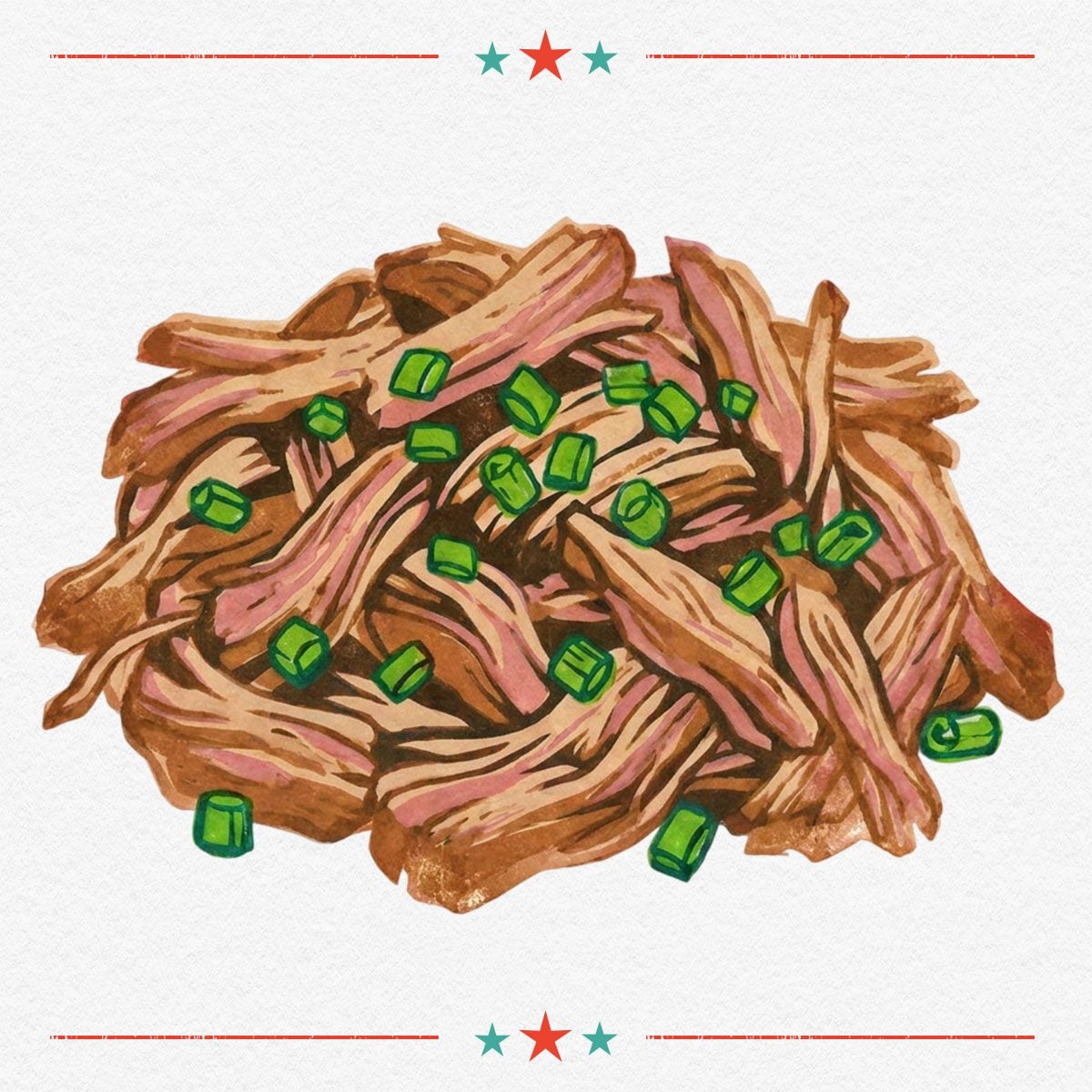
Kalua pig is traditionally cooked in an imu until it’s tender enough to shred, although many home cooks make slow-cooker kalua pork for ease. Imu-cooked pork is seasoned simply with Hawaiian sea salt because it develops its smoky flavor naturally, but versions made without live fire rely on liquid smoke. Either way, the pork gains a smoky flavor that’s surprisingly simple and deeply satisfying.
Lau lau
While kalua pig gets most of the attention, Ippy believes another traditional dish deserves equal recognition. “Lau lau is a savory dish made by wrapping chunks of pork and salted fish in lu’au leaves, the leaves of the taro plant,” he says. “The bundles are then tightly wrapped and steamed in an imu, allowing the flavors to meld together.” The result is a deeply rich, tender dish that remains a beloved staple of Hawaiian cuisine.
Huli huli chicken
If you’ve ever driven through Hawaii and spotted smoke billowing from a roadside stand, there’s a good chance huli huli chicken was cooking nearby. “Once you see that, you pull over,” Sheldon says. “It’ll probably be the best chicken you’ve ever had.”
The name comes from the Hawaiian word huli, meaning “turn,” a reference to the many times the chicken is turned as it’s cooked on the grill. The chicken is marinated in a sweet-savory mixture of ingredients like pineapple juice, soy sauce, ketchup, garlic and ginger. The marinade doubles as a sticky-sweet glaze that’s brushed over the chicken as it cooks.
Kalbi ribs
Few dishes better represent Hawaii’s multicultural food culture than kalbi ribs. Inspired by Korean barbecue, the thin-cut short ribs are marinated in a mixture of shoyu (soy sauce), sesame oil, brown sugar, garlic and ginger before being grilled until caramelized. But Hawaii puts its own spin on the dish. “In Hawaii, we tend to marinate it much sweeter and more candy-like than what you would see typically in Korea,” Sheldon says.
Hawaiian-style kalbi is a staple at family gatherings and beach cookouts across the islands. In fact, when asked about his earliest memories of barbecue in Hawaii, Sheldon immediately recalled, “Smelling kalbi ribs being cooked over the fire at the beach park.”
Teriyaki beef or chicken
If you order a barbecue plate lunch, you’ll likely get a serving of teriyaki beef or chicken. The meat is seasoned with a rich marinade, which sometimes includes pineapple. However, Ippy says that pineapple isn’t nearly as central to Hawaiian barbecue as many mainlanders assume. Instead, flavors like soy sauce, ginger, garlic, sugar and vinegar form the foundation of many of the marinades and sauces used in Hawaiian cuisine. Ippy estimates these ingredients appear in more than half of Hawaii’s local dishes.
Chicken katsu and mochiko chicken
These dishes aren’t grilled or smoked, so they’re not barbecue in the technical sense, but they are plate-lunch staples in Hawaii. Their popularity reflects the strong Japanese influence that has shaped Hawaiian cuisine.
It’s widely debated which is the better choice, but you really can’t go wrong with either. Chicken katsu features a thin chicken cutlet that’s coated in panko breadcrumbs and fried until golden brown. It’s served with a tangy tonkatsu sauce that tastes somewhat reminiscent of barbecue sauce. Mochiko chicken is Hawaii’s version of popcorn chicken, featuring bite-sized pieces of chicken battered with sweet rice flour. After it’s fried, the crispy bites are usually topped with furikake seasoning and drizzled with spicy mayo.
Loco moco
“Loco moco is not necessarily barbecue,” Sheldon says. Instead, he traces the dish back to local surfer kids who walked into a diner looking for something filling to eat. The comfort-food classic was born when a hamburger patty was served over white rice and topped with brown gravy and a fried egg.
While it may not have roots in traditional Hawaiian cooking, Sheldon calls it “definitely Hawaii,” noting that you’ll find some version of loco moco at drive-ins, plate lunch spots and local restaurants throughout the islands.
Essential Hawaiian barbecue sides
No Hawaiian barbecue plate is complete without the sides. Here are some of the more common ones you’ll find on a plate lunch:
- Rice and macaroni salad: The combination of rice and macaroni salad might seem unusual at first, but locals wouldn’t have it any other way. Rice is an inexpensive staple starch that was brought to the islands by Japanese and Chinese immigrants, while the filling macaroni salad reflects Western influences and available wartime ingredients. Sheldon describes macaroni salad as the element that bridges the gap between the rice and protein, adding richness to every bite. In Hawaii, recipes often lean heavily on mayonnaise, creating a creamy contrast to smoky grilled meats.
- Poi: Made from steamed and pounded taro root, poi is one of Hawaii’s most culturally significant foods. “Poi is a nutrient-packed superfood,” Ippy says. “It was the first thing my daughters ate as babies.” Its flavor can range from mildly sweet and earthy to slightly tangy as it ferments. In Native Hawaiian tradition, taro holds profound cultural significance. Hawaiian genealogy traces the taro plant and the Hawaiian people to the same ancestral origins, making taro far more than a staple food—it’s regarded as an ancestor and remains deeply connected to Hawaiian identity and tradition.
- Lomi lomi salmon: The word lomi means “to massage” or “to knead” in Hawaiian, referring to the gentle mixing motion used to combine the salted salmon, tomatoes and onions. It’s rarely served as a main dish, instead being offered as a chilled salad or relish on a plate lunch. The refreshing, cold dish is a perfect contrast for savory meats.
- Spam musubi: Spam has become so closely associated with Hawaii that many visitors are surprised to learn how it got there in the first place. According to Sheldon, Spam became common in Hawaii during World War II, when it was distributed as military rations. It eventually found a permanent place in local pantries. Its most famous form is Spam musubi, a piece of pan-fried Spam that’s brushed with a sweet-savory glaze and wrapped up with rice in a piece of seaweed. The portable snack is sold everywhere from convenience stores and grocery stores to airport kiosks.
- Chili pepper water: Nearly every family seems to have their own version of chili pepper water. Ippy calls the spicy condiment “our local hot sauce.” Recipes can vary widely, but they typically start with Hawaiian chile peppers and water, and then may include salt, vinegar, garlic, soy sauce or fish sauce.
- Haupia: For dessert, look for haupia. Made from coconut milk and starch like cornstarch or arrowroot, this traditional Hawaiian sweet has a texture somewhere between pudding and gelatin. It’s commonly served at luaus, family gatherings and celebrations, either on its own or incorporated into pies and other desserts.


