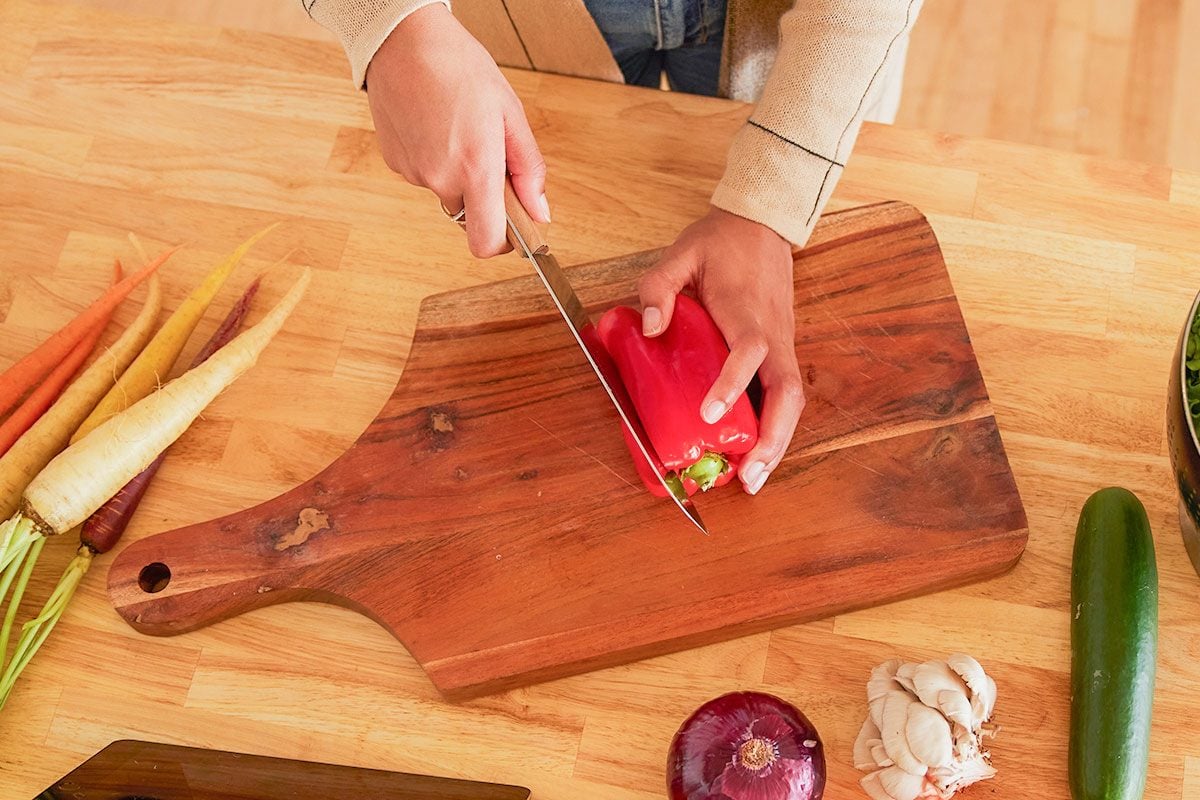
A small change to your setup makes chopping much safer.
Culinary school was one of the most fun seasons of my life so far. Its long days smelled like onions and stock, and sounded like the steady rhythm of knives against cutting boards—the low hum of everyone trying to get just a little better, a little faster. I was learning how to build sauces from scratch, how to break down a chicken properly, and how to taste something once and know exactly what it needed. And somewhere between knife skills and Pastry 101, I met my husband—easily the best thing I picked up on my educational journey.
He went on to cook professionally, while I took the journalistic route. But both of us carried the same habits we learned at school into our careers and the homes we’ve shared together ever since. One of those habits we rely on daily for safety and efficiency when using a cutting board. It works equally well in both his restaurant kitchen and in our home, and it doesn’t require fancy equipment or culinary-school bravado. Just a paper towel and a little water!
How a Damp Paper Towel Keeps Your Cutting Board from Slipping

Before you start slicing and dicing, tear off a paper towel from your roll, run it briefly under the faucet, and wring it out so it’s damp but not sopping wet. Smooth it flat on the counter, and set your cutting board directly on top. That thin layer of moisture creates friction between the board and the countertop, anchoring it in place. Instead of shifting when you push or pull with your knife, the board will stay steady. It won’t scoot its way down the counter until you’re bracing it with your hip halfway through dicing an onion.
It’s a small adjustment, but the difference is immense. When the surface beneath you is stable, your knife feels steadier too. You’re not tightening your grip without realizing it. Even something dense like a sweet potato or winter squash feels more manageable when the board underneath it isn’t sliding around.
A damp dish towel works just as well. Some cooks even keep a strip of rubber shelf liner in a drawer for the same reason. Anything that gives the board a little grip against the counter will do, but I reach for a paper towel every time. When I’m finished prepping, I use it to wipe down the counter and gather stray onion skins before I toss it.
Why a Stable Cutting Board Matters More Than You Think
A cutting board that moves is not just annoying; it’s very dangerous. When a cutting board slides under your knife—even slightly—it changes your control. It throws off your angle at the exact moment you’re relying on it. And when you’re busy in the kitchen, this humble little trick could be the difference between a steady slice and a big injury.
When your board is steady, it changes the entire feel of your prep. Your rhythm is smoother, and your hand is more confident. You can focus on the cut itself—the thickness of the slice, the size of the dice—instead of the surface beneath you.
Related: