Low and slow is not the only way.
Between years of restaurant work, culinary school and recipe testing, I’ve caramelized more onions than I could possibly count. I’ve stood over plenty of skillets slowly coaxing out that deep, jammy sweetness. And if you would have asked me last week whether there were any legitimate ways to speed up the process, I would have said no.
Caramelized onions are one of those things I’ve always considered immune to shortcuts. Low and slow wasn’t just the best method—it was the method. Every cookbook, every chef and every cooking class drilled the same lesson into my head: If you want properly caramelized onions, you need patience. I’ve carried that advice for years.
So when I saw a chef on Instagram claiming he could cut the cooking time in half with a microwave, I assumed it would be another internet shortcut that confused “faster” with “good enough.” Instead, it managed something I didn’t think was possible, and it made me completely rethink one of my strongest and longest-held cooking beliefs.
What is the onion microwave trick?
The method comes from Seattle chef Charles Kim, better known online as Chef Fatty. Instead of starting the thinly sliced onions in a skillet, he microwaves them for about 10 minutes before they ever touch the stove.
The science is surprisingly straightforward. Onions are mostly water, and microwaves are exceptionally good at heating water. As that water rapidly heats, it bursts the onion cells and softens their structure, doing much of the work that normally takes 30 to 40 minutes on the stovetop. In other words, the microwave isn’t caramelizing the onions; it’s preparing them for caramelization.
Still, I was convinced there had to be a catch.
How to Caramelize Onions in a Microwave

I was skeptical enough that I only committed two yellow onions to the experiment. If it failed, I’d rather have sacrificed two onions than four. Of course, anyone who has made caramelized onions knows that two onions somehow becomes almost no onions. They belong in the same category as sauteed spinach, where an entire mountain mysteriously cooks down into a lump that could fit on a single cracker.

I sliced them thinly, microwaved them for 10 minutes, then opened the door to find what can only be described as an onion sauna. A cloud of onion-scented steam billowed out, and the inside of the microwave door was covered in condensation. That moisture—which came from the onions—was the very same moisture you’d normally spend ages cooking off in a skillet.

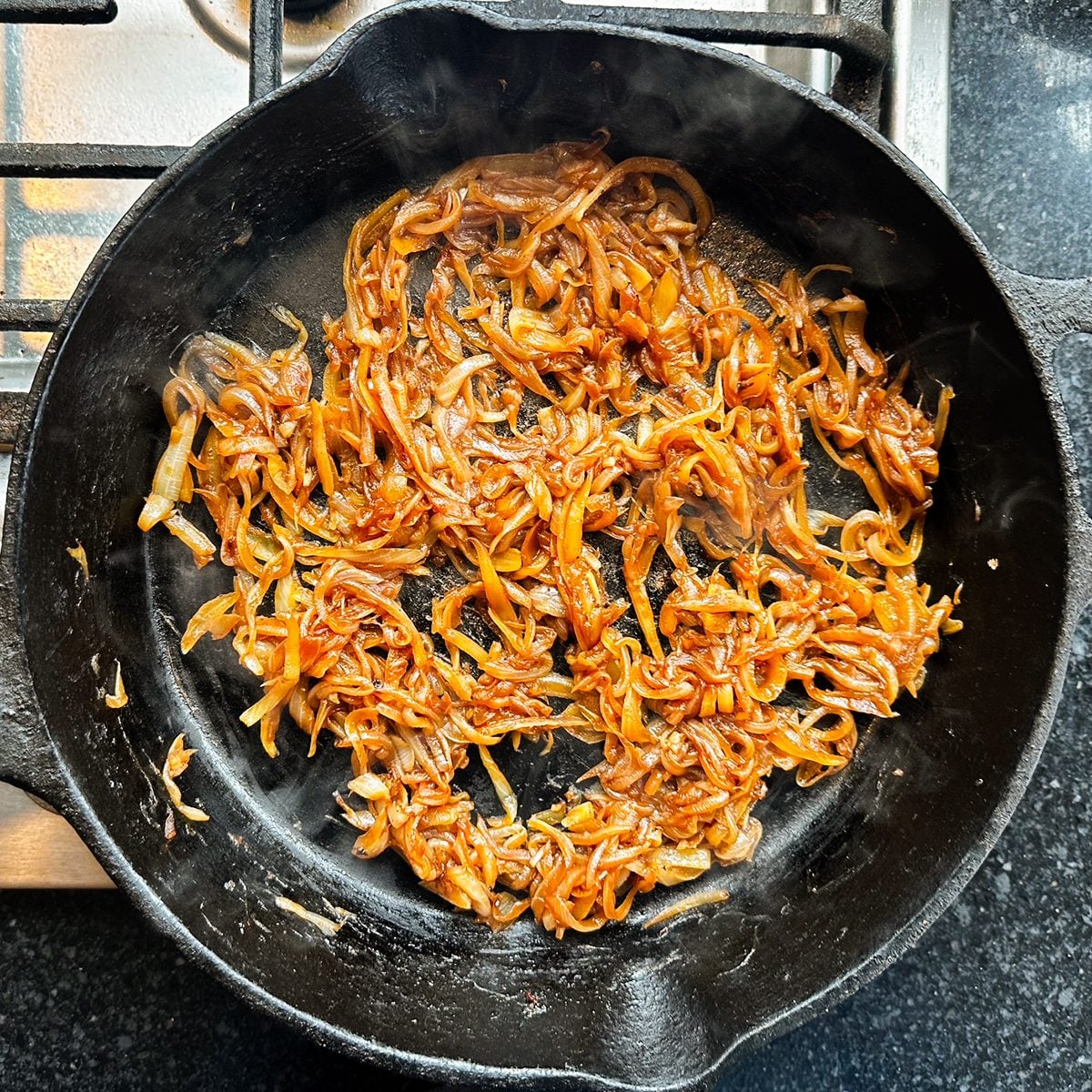
I tipped everything, liquid from the dish included, into a cast-iron pan and cooked the onions exactly as I normally would, adding little splashes of water whenever they started to stick to the bottom. Those quick additions of water loosen the flavorful browned bits from the pan, preventing scorching and giving the onions time to continue their breakdown into a soft, jammy tangle.
Sixteen minutes later, they were done. Not “pretty close.” Done.

The onions had turned a beautiful, deeply caramelized brown with glossy strands that practically melted into one another. They were intensely savory, sweet enough without tasting sugary, and every bit as silky as batches I’ve spent over an hour making the traditional way.
Twenty-six minutes. That’s all it took to go from from raw onions to beautifully caramelized onions.
I had always treated the entire hour-long process as essential. But so much of that time is simply waiting for the onions to soften and give up their moisture. The microwave handles that part with startling efficiency, leaving the skillet to do what only the skillet can do: evaporating the remaining water and developing all those rich browned flavors.
As someone who’s spent years insisting caramelized onions simply can’t be rushed, consider this my official retraction.
Related: