
Another yogurt has entered the chat. But what exactly is the difference between Bulgarian yogurt and Greek yogurt?
Our editors and experts handpick every product we feature. We may earn a commission from your purchases.
Learn more.
On a recent trip to Sprouts, something in the dairy aisle caught my eye: a massive jar decorated with pretty red illustrations. Bulgarian yogurt? I thought, introducing to my brain those two words side by side. So far, I knew of protein-packed Greek yogurt, super-thick Skyr Icelandic yogurt, drinkable kefir and dairy-free coconut yogurt. But I had never heard of Bulgarian yogurt.
I opened the heavy glass door and took out the White Mountain jar for a closer look. It was covered with labels like “up to 90 billion CFUs per serving” (huh?), “made in Austin, TX” (wait, not Bulgaria?) and “single-source dairy” (so, from one farm?). My curiosity sparked, the jar went into the cart, along with a container of my go-to Fage 5% Greek yogurt (just in case I didn’t like the Bulgarian variety).
What makes Bulgarian yogurt different?
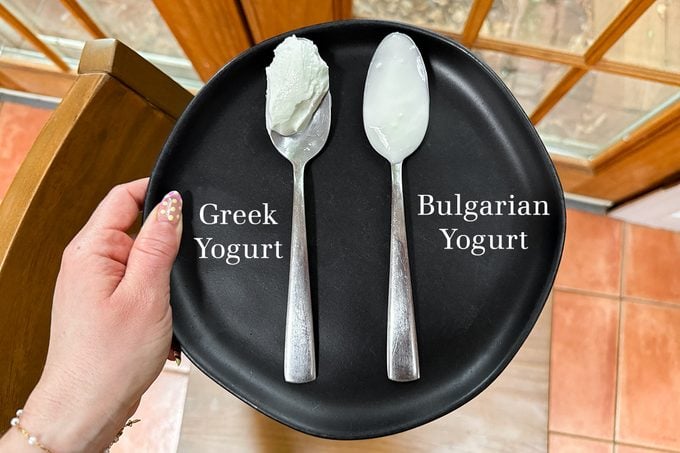
I did some research to find out how Bulgarian yogurt was different from Greek yogurt, and it turns out they share a lot of similarities. All yogurt is made by fermenting pasteurized milk with live cultures, creating a product rich in probiotics. But the ratio of the cultures used and how long the yogurt is fermented create varying flavor profiles. That makes Bulgarian yogurt distinctly sour and tangy, whereas Greek yogurt is milder and creamier. Greek yogurt is also strained, making it much thicker and concentrating its protein content.
Bulgarian yogurt also has a very high number of CFUs (colony forming units), the number of living bacteria per gram. According to Harvard Health’s The Nutrition Source, yogurt must contain at least 1 million CFUs to display “Live and Active Cultures” on its packaging. Bulgarian yogurt has up to a whopping 90 billion CFUs per serving, making it a powerhouse ingredient for gut health. All those probiotics support digestion, boost the immune system and create a well-supported gut microbiome.
What I Thought About Bulgarian Yogurt
As soon as I got home from the store, I twisted open the jar. Bulgarian yogurt had a really loose texture and almost looked a little curdled. It smelled nose-crinklingly sour, but not in a bad way—more like lemons than astringent vinegar.
I gave it a good stir and tasted a spoonful. It was, by far, the most sour, tangy yogurt I’ve ever tried. But not so sour that I didn’t want to dive back in! After a second spoonful, I even kind of liked it. In some ways, it reminded me of unsweetened lemon curd: tart and creamy with a notably acidic aftertaste.
Ways to Enjoy Bulgarian Yogurt
After my taste test, I’m ready to go all-in with Bulgarian yogurt. Since Bulgarian yogurt isn’t sweetened like many yogurts on shelves, it may take some getting used to before eating it plain. I suggest enjoying it with sweet ingredients (like fruit and granola) until you get used to its characteristic tanginess. Or, try it in recipes with yogurt, like baked goods or marinades.
- Drizzle it on an oatmeal bowl: My favorite way to eat Bulgarian yogurt is in my morning oatmeal bowl with dates, raspberries and maple syrup. Try adding it to your favorite oatmeal recipes, like summertime oatmeal or bananas Foster oatmeal.
- Use it in baked goods: Some baking recipes call for yogurt to add moisture to the dessert. Wherever a baking recipe calls for yogurt, feel free to swap in Bulgarian. Try it in grapefruit yogurt cake or fluffy yogurt pancakes. You can even use it as a sour cream replacement in recipes like sour cream banana bread.
- Add it to your marinades: Yogurt is great as a marinade because it helps tenderize meat. Use it in cauliflower tikka masala, tandoori-style chicken or curried chicken meatball wraps.
- Try it in Bulgarian dishes: Go back to Bulgarian yogurt’s roots with traditional Bulgarian dishes like tarator (a cold soup made with yogurt, cucumber, garlic and dill), banitsa (a phyllo dough pastry stuffed with eggs, cheese and Bulgarian yogurt) or snezhanka (a dip similar to tzatziki).